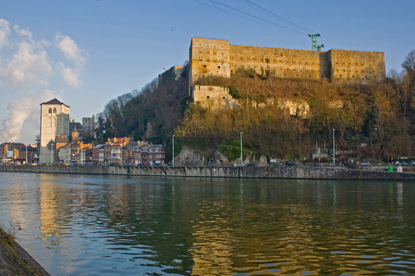
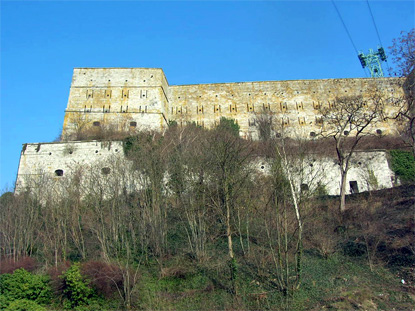
 Citadel and Collegiate Church of Huy. Citadel and Collegiate Church of Huy.
Introduction
Located halfway between Namur and Liege, Huy (pop. 20,000) is a charming little town at the confluence of the Meuse, Mehaigne and Hoyoux Rivers.
Huy has a history going back to Roman times and played a major role in Belgian and European history during the Middle Ages.
History
Huy is one of Belgium's oldest towns. The Romans built a castrum (fortified town) here in the 2nd century. The name Huy first appears in official documents in the 6th and 7th century under the Latinised form Hoius vicus (also Hoium or Hoio).
Holy Roman Emperor Otto I created the County of Huy in 941. As soon as 985, however, Ansfried, Count of Huy, died heirless and Huy came under the control of the Bishop of Liège, Notger (940-1008). By absorbing the county, Notger acquired secular authority and consequently became the first Prince-Bishop of Liège.
Huy quickly developed as a major artisanal and commercial centre, noted for its tanners, cauldroners, carpenters and especially for its jewelers. The town's name derives from the smaller of the three rivers, the Hoyoux, which provided clear water to the wool and leather workers in the Middle Ages.
In 1066, Bishop Theodwin of Bavaria sold half of his possessions to finance the construction of Huy's cathedral, and gave the town Western Europe's first charter of liberties.
The First Crusade (1096-99, see Bouillon) was a prosperous age for Huy, and the headquarters of the Order of the Crusaders was founded in a convent in Huy. Huy traded as far as Russia and Scandinavia in the 13th and 14th centuries.
Huy Castle ("Li Tchestia", as it is known in the local Walloon dialect) became a powerful fortress, where the Princes of Liege sought refuge during conflicts with the populace, and it became the town's symbol in the 15th century.In the aftermath of the War of Spanish Succession, the Third Barrier Treaty (1715) ordered the destruction of the castle, after having sustained dozens of sieges in its history.
In 1818, a new fort was built under the Dutch rule, at the same time as in Dinant's citadel, and it became the target of German troops in both WWI and WWII.
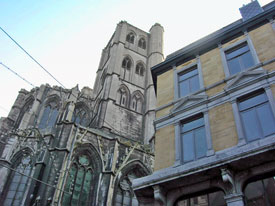
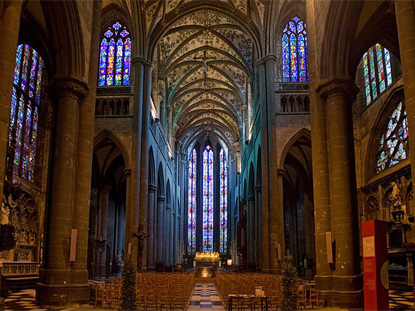 Collegiate Church of Huy. Collegiate Church of Huy.
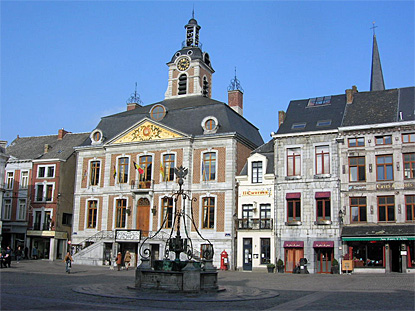 Townhall of Huy on the Grand Place.
Attractions
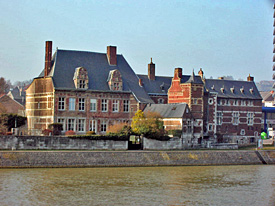
The town's historical centre is typically Mosan in style, although with more bluestones than in Namur and Liege.
The Hôtel de la Cloche built in 1606 and the 16th-century Hospice d'Oultremont are two of the most radiant examples of Mosan architecture in Huy.
Huy's Collégiale de Notre-Dame (Our Lady's Collegiate Church) was built between 1311 and 1536 in the mid and late Gothic styles. The Collegiate Church houses an illustrious treasury containing works of art dating from Huy golden age in the 12th and 13th century.
The Fort de Huy (see history above) can accessed via the téléphérique (cable car), running since 1957 - and renovated in 2004.
Other notable buildings include the Maison Batta (16th &17th c.), the Ponton (16th & 17th c.), the Abbey of Aulne (16th c.), the St Victor's Abbey (18th-c.), the St Stephen-at-the-Mount's Church (Eglise St-Etienne-au-Mont, 17th & 19th c.), Wanze's sugar factory (sucrerie), the Hôtel de Ville (townhall, 18th c.), the Palais de Justice (court of justice), the île des Béguines, and three bridges (pont de fer, pont Père Pire and pont Baudouin).
There is a nuclear plant in the nearby town of Tihange, although that does not really qualify as "sightseeing" to most people.
Castles around Huy
There are several interesting castles open to the public near Huy, such as the medieval fortress of Moha and the two following ones.
The Mosan style Château de de Tihange dates back to the 10th century when it was used as a villa by Saint Jean l'Agneau, bishop of Tongeren-Maastricht. The present building was reconstructed in 1576 by Charles de Pottiers, and further improved in the late 17th century by Count Jean-Baptiste de Nuvolara.
Also of 16th-century Mosan style, the Château de Bonne-Espérance used to be a house of the Order of the Templars 7 hundred years ago. It now operates as a hotel .
How to get there
Huy is easily accesible by train on the Namur-Liege line. The journey takes 18 to 31min from Namur and 20min from Liege.
There are two ways to reach the city by car from Namur (45km) or Liege (40km). The fastest way is to take the E42 motorway, then exit 7 for Huy. The more picturesque N90 follows the meanders of the Meuse, with numerous high cliffs and a few castles on a way.
| 

 Luxembourg Guide
 Netherlands Guide


