
|

Eupedia Community
|
 Town Hall of Antwerp.
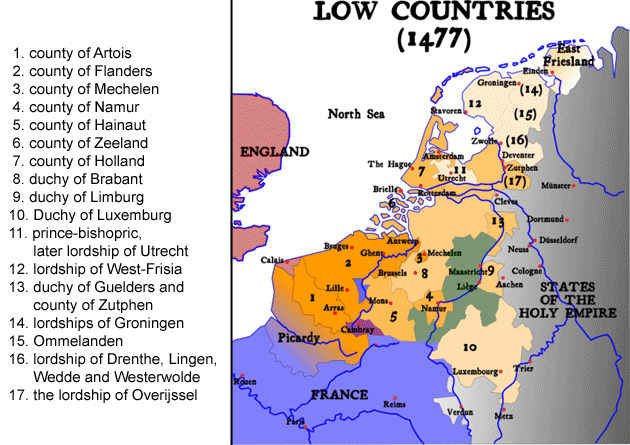
A bit of historyThe Benelux region, composed of Belgium, the Netherlands and Luxembourg, was historically known as the Low Countries or the Netherlands. After the independence of the northern provinces (Dutch Republic) from their Habsburg rulers in the 16th century, the southern provinces (Belgium, Luxembourg, but also Maastricht, and most of the Nord-Pas-de-Calais in France) became known as the Southern Netherlands or the Habsburgian Netherlands. Antiquity & Middle AgesAfter Julius Caesar's conquest in 59 BCE, Luxembourg, Belgium and the south of the Netherlands belonged to the Roman province of Belgica, making up the sub-province of Germania Inferior with the part of Germany west of the Rhine. From the 3rd century, the Franks settled in most of modern Benelux. Tournai, in Belgium, became the seat of the Merovingian dynasty, from where Clovis unified the Frankish tribes and conquered the remains of Roman Gaul. From the 7th century, the power of the Frankish court shifted to the region of Liège with the Carolingian dynasty. Charlemagne moved the capital of his empire in nearby Aachen, which can be considered as historically part of the Low Countries. Part of the Holy Roman Empire from the 9th century (except the County of Flanders that was part of France), the Benelux region came under the control of the Dukes of Burgundy by a series of political marriages in the 14th century. This era became known as that of the Burgundian Netherlands (1384–1482). Renaissance & Modern TimesThe last Duchess of Burgundy married Emperor Maximilian I of Habsburg in 1468, opening the Habsburgian era for the Low Countries. Emperor Charles V (1500-1558), who ruled over the Holy Roman Empire, Austria, Spain and half of Italy, was born and raised in Ghent, in Flanders, with French as his mother-tongue. The Low Countries were then the political centre of the Habsburgian Empire. In 1556, Charles V abdicated and divided his empire between his brother Maximilian, who inherited Germany and Austria, and his son Philip, who was bequeathed Spain and the Low Countries. King Philip II of Spain, as he became known, was fervently Catholic and his harsh stance against Protestantism prompted a rebellion which resulted in the independence of the mostly Calvinist northern provinces. The United Provinces, or more formally the Republic of the Seven United Netherlands as they officially referred to themselves, were the forerunner of the modern Kingdom of the Netherlands (founded by Napoleon in 1806). The Southern Netherlands remained under Habsburg rule until the French Revolution, under the appellation of Spanish Netherlands (1556-1714), then Austrian Netherlands (1714-1792), depending on which branch of the Habsburg dynasty controlled the region. This area later became the Kingdom of Belgium (from 1830) and the Grand-Duchy of Luxembourg (from 1815). The relatively large Prince-Bishopric of Liège, which comprised most of today's provinces of Limburg, Liège, and half of the province of Namur, never belonged to the Habsburgian Netherlands (inevitably since prince-bishops were elected and did not marry). After Burgundy's annexation to France in 1477, the Principality of Liège was the only predominantly French-speaking state left in the otherwise German-speaking Holy Roman Empire. History's political intrigues has left some regions divided between present-day countries. For instance, the historical Limburg is now shared by Belgium and the Netherlands, while half of the old Duchy of Luxembourg now makes up the Belgian province of Luxembourg. Likewise, the medieval Duchy of Brabant used to span from the north of Wallonia (Walloon Brabant) to the south of the Netherlands (North Brabant). In addition to the three provinces still called 'Brabant' today, a big chunk of the old duchy has become the province of Antwerp, while another is the region-state of Brussels. Well before it became the capital of Belgium (and the EU), Brussels had been the historical capital of the Burgundian, then Habsburgian Netherlands for over four centuries.
Historical PopulationsNowadays the Netherlands may assume a role of "big brother" with Belgium, due to its larger size, population and economy. But that would be historically wrong. Ever since Roman times, the region corresponding to modern Belgium was always considerably more populous than what is now the Netherlands. In 1816, a few years after Napoleon introduced compulsory civil registry, Belgium had a population of 4.6 million, against only 2 million for its northern neighbour. In 1900, the Belgian state had grown to 6.7 citizens, while the Dutch had experienced a major population boom, boosting their numbers 2.6 fold to 5.2 million. It is only in the middle of the 1930's that the Dutch population overtook that of Belgium, with about 8 million inhabitants for each country. Since then, the Netherlands' population has doubled to 16.7 million, while that of Belgium only increased by 30%, to 10.5 million. GeographyBelgium is made up of 10 provinces, part of 3 region-states : Flanders (Dutch-speaking) to the north, Wallonia (French-speaking) to the south, and Brussels (bilingual) in the middle. Luxembourg is about the same size as a Belgian province. If it was part of Belgium, it would be one of the 3 least populous province, along with the provinces of Namur and Luxembourg. The Netherlands is divided in 12 provinces. Only 2 of these are called 'Holland' : North Holland and South Holland. The term "Holland" is often confused for "Netherlands", as the region of Holland happens to be the touristic and historically important area, where over one third of the present population lives. However, it is just as incorrect to refer to the whole country as 'Holland' as it is to refer to the UK or Britain as England. If you do refer to the country as Holland local people might get offended, especially outside the two provinces of Holland. The adjective 'Dutch' refers to the whole Netherlands. Ducth language is called nederlands in Dutch. Tourism in the BeneluxWhat to see in the Benelux ? On top of the list is the wealth of historical architecture, which can date back to over 1000 years, especially in Wallonia, where hard grey stone is the traditional construction material. About all cities and towns have their market square, with generally a magnificient late Medieval or Renaissance townhall, a magnificent medieval cathedral or collegiate church, and for Belgian cities also a belfry - a tower symbolising the town's charter of liberties towards the local lord in medieval times. Belgium is also renowned for its castles: over 3000 of them, enough to find one you like. It is in Wallonia, and particularly the Meuse Valley, that castles are the most abundant. The country also has plenty of beautiful abbeys, old churches and quaint villages (again mostly in Wallonia, especially along the Meuse Valley). The Low Countries have produced some of the world's finest Medieval, Renaissance, Baroque and Modern painters. While the Netherlands can claim such names as Hieronymus Bosch, Rembrandt, Jan Vermeer, Jan Steen, Frans Hals, Vincent van Gogh or Piet Mondriaan, Belgium boasts equally impressive names with Van Eyck, Bruegel (4 of them), Memling, Rubens, Van Dyck, Ensor or Magritte. Naturally, most of the finest works of the artists can be viewed in museums around the Benelux. In the Netherlands, you can relax by renting a boat on one of the innumerable canals, and not just in the cities, the whole country is full of them ! Where else can you see boats between sheep fields ? However, the Dutch are the ones who invade their southern neighbours in the summer to enjoy various sporting activities (hiking, horse riding, kayaking...) in the (relative) "wilderness" of the Ardennes forest, in southern Wallonia and in Luxembourg. What is each country famous for ?The Netherlands is probably one of the world's most stereotyped country. Think of it and images of tulips, canals, bicycles, clogs, windmills and Gouda cheese spring to mind. Delftwares are named after the Dutch town that manufactures them : Delft. Note that there are also windmills and lots of bicycles in Flanders. Belgium has its fair share of preconceived images too, especially about food : chocolates, waffles, beer and chips ("French" fries). Tourists also buy Renaissance-style tapestries (gobelins) or lace, which once made Flanders one of the busiest textile centre in Europe. But one of the best things Belgium has to offer is its incredible number of castles (1 every 10 km² in average, the highest density of any country in the world). Luxembourg is too small to have influenced the world with its products. It does make nice white wine, but what made its international fame are its banks and low taxes. Highlights of the BeneluxBest citiesBy alphabetical order :
Best town halls
Best belfries
LinksBelgian townhalls & belfriesBelgian cathedrals Belgian castles Transportation in the BeneluxShort distances and high density of population mean that moving around the Benelux is fairly easy and fast. For instance, towns like Delft, Gouda, Rotterdam or Leiden are all within 20min from The Hague. Major Belgian cities can all be reached within one hour from Brussels. However, when it comes to exploring the Belgian countryside, be it picturesque stone villages, castles or abbeys, a car is absolutely necessary. A lot of visitors miss two thirds of the sights in Belgium because they don't make the effort of renting a car. Everywhere in the Benelux trains are more numerous and more convenient than buses. Many discount cards and passes are available for trains:
Both railway companies offer discounts on return tickets and especially weekend return. Likewise, there are discounts for people under 26, over 60, groups, students, etc. Trains in Belgium tend to be slightly nicer than in the Netherlands, with clearer annoucements and more signs inside stations. However, Dutch stations are often cleaner and more beautiful. Note that annoucements are usually only in Dutch in the Netherlands and bilingual Dutch and French in Belgium. Only international train (e.g. from Brussels to Amsterdam) have annoucements in English. Dutch stations now have electronic ticket vending machines with menus in Dutch, English and French. Payments can be made in cash or by debit card (Maestro). Most Belgian stations don't have such machines, and when there are, they tend not to work properly - so just go to the counter, or buy your ticket in the train if you board from a rural station with no staff. Keep in mind that areas located along railways in the Benelux tend to be the dodgiest ones, especially in big cities. Station areas around big cities are often run-down, dirty, and zones of predilection for prositution. Don't expect bucolic landscapes while travelling between the densely populated Randstad (Den Haag-Rotterdam region), or anywhere between Antwerp and Brussels. The worst stations in terms of cleanliness, frequentation and immediate neihbourhood are Den Haag HS, Rotterdam, Antwerp-Berchem, Brussels North (except the western and southern neighbourhood) and Brussels South. The rest of Benelux tends to be much better in this regard though. Travel CommunityAsk your travel questions on the Benelux Travel Forum | |||||||||||||||||||||||||||||||||||||||||||||||||||||||||||||||||||||||||||||||||||||||


| Eupedia |
|---|
| |||||||||||
Copyright © 2004-2022 Eupedia.com All Rights Reserved.