History of the Franks
Origins of the Franks
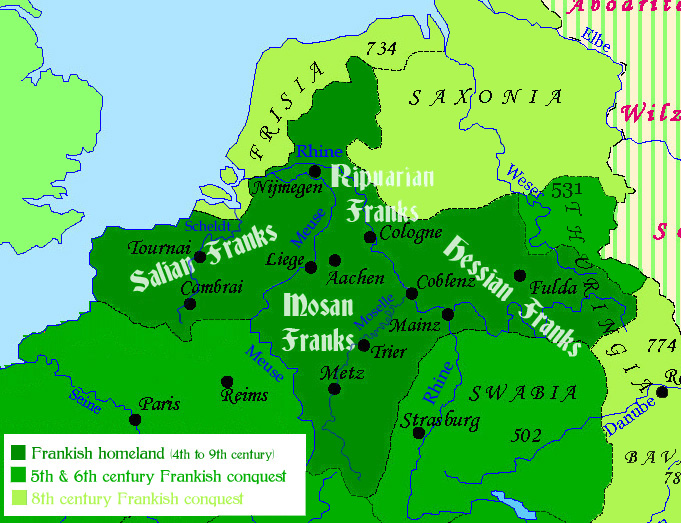
The Franks, like other West Germanic tribes, is thought to have descended from Denmark or Schleswig-Holstein in the Early Iron Age (c. 500 BCE) through Lower Saxony. The Franks would have settled in the northeastern Netherlands, as far as the Rhine, circa 200 BCE. Around the 2nd and 3rd century C.E. they crossed the Rhine moved into Toxandria, the Southern Netherlands (modern Belgium) and the German Rhineland. By the 6th century, the Franks had expanded to Lorraine, the Palatinate and Hesse. The Franks were divided in several tribes, such as the Salian Franks in Flanders (including French Flanders) and Zealand, the Mosan Franks in Wallonia, Luxembourg and Lorraine, or the Ripuarian Franks in the Rhineland region.
The Rhine and Moselle valleys in Germany are still known as "Franconia", and German dialects in this region are varieties of Franconian, direct descendants of the Old Ripuarian Frankish. Old Salian Frankish evolved into Dutch and Flemish dialects.
| Genetics of the Franks |
|---|
|
Based on the results from the Benelux Y-DNA Project it can be inferred that the Franks's main paternal lineage was haplogroup R1b-U106, and that they belonged overwhemingly the Z381 subclade. They also possessed other typical Germanic lineages like I1, I2a2a and R1a (L664 and Z283 subclades), although their ratio to R1b-U106 would have been 1:2, 1:6 and 1:7 respectively. Like modern Scandinavians, the Franks also probably carried a substantial amount of R1b-P312 lineages, including the L21, U152 and DF27 subclades, as well as a minority of E-V13, G2a3b1 and J2. Since all these lineages are also typical of population of Celtic or Italic (including Roman) descent, is not clear at present what proportion of these lineages in the Benelux can be attributed to the Gauls and the Romans, as opposed to the Franks.
|
The Salian Franks
In 287/288 C.E. Roman Emperor Maximian (250-310) launched a military campaign in Germania against the Franks. The Salian Franks surrendered and became subjects of the Roman Empire. Maximian moved them to Germania Inferior (roughly present-day Belgium), making them the first Germanic tribe to settle permanently within the Roman Empire.
They became a powerful ally of Rome, providing many imperial generals (notably Salia and Arbogast). In 324, Bonitus becomes the first Frank in charge of a Roman militia. In 351, Gaiso becomes the first Roman consul of Frankish blood, followed by Silvanus in 355, Nevitta (a personal friend of Emperor Julian) in 362, Merobaudes in 377, Richomeres in 384, Bauto in 385. The Franks integrated remarkably well into Roman society, speaking Latin fluently, obtainning Roman citizenship, and being often promoted by the emperors to consular ranks (including senators) for their competence. Some of them were even granted the clan name Flavius of the Imperial family.
Frankish kingdoms were established within the Empire, around Le Mans (northwestern France), Cambrai (northern France), Tournai (Wallonia, Belgium), Trier (Rhineland-Palatinate, Germany), and Deutz (now within Cologne, North-Rhine, Germany).
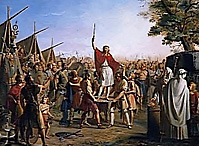
Chlodio the Long-Haired (395-448) is considered to be the founder of the Merovingian dynasty, named after his son Merowig/Meroveus (447-458). The Roman army having left the north of Gallia Belgica (present-day North of France) to fight the Visigoths, Chlodio took control of the region, extending his realm between the Rhine, the Meuse, the Somme and the English Channel. He established his capital in Tournai, which the Romans had founded around 50 C.E. His grandson, Childeric I (437-482), helped the Romans defeat the Visigoths.
The conquest of Roman Gaul
Childeric's son, Clovis I (466-511), also born and raised in Tournai, conquered the neighbouring Frankish tribes in the Low Countries and Rhineland and established himself as their sole king. He defeated Syagrius, the last Roman official in northern Gaul, then the Visigoths in southwestern Gaul, thus becoming the ruler of most of the old Roman Gaul.
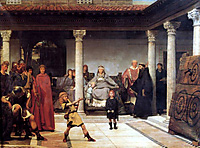
Clovis converted to Catholicism at the instigation of his wife Clotide, a Burgundian princess, thus spreading Christianity among the pagan Franks. The Romans had been predominantly Christian since the 4th century, after Emperor Constantine converted to Christianity (312 C.E.), and Emperor Theodosius declared Christianity as the official state religion of the Roman Empire (380 C.E.). Converting to Christianity was therefore a way of showing the continuity between the Roman and Frankish rules. Most importantly, it was a way of earning the acceptance of the Christian Gallo-Roman population, which greatly outnumbered the Frankish rulers. It took many generations before the Franks truly adopted Christianity. Even at the time of Charlemagne, 300 years after Clovis, a part of the Frankish population was still pagan.
Clovis I is considered by many French people to be the first King of France, although he was really the King of the Franks. The name 'France' does come from 'Frank', but it only appeared in the 10th century, after the split of Charlemagne's Empire (see below). Under the Merovingians, most of what is now France was called 'Neustria', while the Benelux together with western and southern Germany were known as 'Austrasia'.
Saving Europe from Islamisation
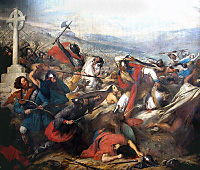
After two centuries of rule, the waning power of the Merovingian dynasty prompted Charles Martel (686-741), a native from Liège, to proclaime himself Duke of the Franks and was in all but name de facto ruler of the Frankish Realms.
In 732, he routed the invading Islamic Moorish armies of the Umayyad Caliphate at the Battle of Poitiers (also known as the Battle of Tours), thus saving Europe from Islamisation. This is one of the most important achievements of the Franks in the history of Europe up to this day. Without Charles Martel, Europe, or at least Western Continental Europe, would have become part of the Muslim world, an event that would almost certainly have prevented the Renaissance from happening, and would consequently also have precluded the Great Voyages, the Colonisation, the Enlightenment, the Industrial Revolution, and everything that follows. Without Charles Martel, Europe might well have stagnated to the medieval period to this day. As a result, modern technologies wouldn't exist anywhere on Earth.
Heirs of the Roman Empire
Upon Charles Martel's death, the power passed to his two sons Pippin the Younger (714-768) and Carloman (706-754), who ruled conjointly over Francia until 747, when Carloman withdrew to monastic life. In 751, the last Merovingian puppet king, Childeric III, was deposed, and Pippin was elected King of the Franks with the blessing of the Pope, and anointed in Soissons.
Pippin's son, Charles (768-814) would extend the Frankish empire to Saxony (see Paderborn), Northern Italy, Croatia, and Catalonia, and become known as Charlemagne (Carolus Magnus in Latin, i.e. "Charles the Great"). In 800, he was crowned emperor by the Pope in Rome, declaring himself heir of the Roman Empire, with his capital in Aachen, 40 km away from his native Liège. His empire was to last over 1000 years (until Napoleon dissolved it in 1806). From 962 it became known under the name of Holy Roman Empire and Holy Roman Emperors were crowned in Rome, stressing the continuity with the original Roman Empire.
Founders of Western civilisation
The Frankish influence over Europe was so important from the Merovingian period onwards that the term for 'European' or 'non-Muslim' became (and remains up to this day) Faranji in Arabic and Farangi in Persian, a derivative of the word "Frank". The term became used in the Indian subcontinent as well after the Muslim conquest. Firang or Farang are also used in South Asia (the latter in Thailand as well) to refer to Westerners.
Since Charlemagne, Emperor of the Occident, became the symbol of the unified Christian Europe in the Muslim world, the Franks have become associated with the image of Westerners in most of southern Asia for over 1000 years. It could be said in a way that the Franks laid the foundations of Western society and culture.
On a side note, understanding history makes it only natural for the modern capital of Europe, Brussels, to be located at the very heatr of the old Frankish homeland. In fact, Brussels was the historic capital of the Duchy of Brabant, which was the official heir of Lotharingia, the Kingdom of Charlemagne's eldest grandson, who was supposed to rule over his undivided empire (his brothers did not see it that way). Therefore, symbolically, Lotharingia remained for centuries the "senior" principality within the empire, and Brussels has inherited the rightful claim of being the symbolic capital of Europe's sole historical empire from 800 to 1804. In the year 1804, the French Empire and Austrian Empire were both founded, conferring for the first time simultaneously the title of emperor to French-speaking and German-speaking monarch. The Holy Roman Empire was officially abolished in 1806 by Napoleon to prevent the Habsburgs from claiming themselves sovereign of Germany. Note that the British Empire was not properly speaking an empire until Queen Victoria was granted the title of Empress of India in 1876).
Founders of the monarchies of France, Germany and Luxembourg
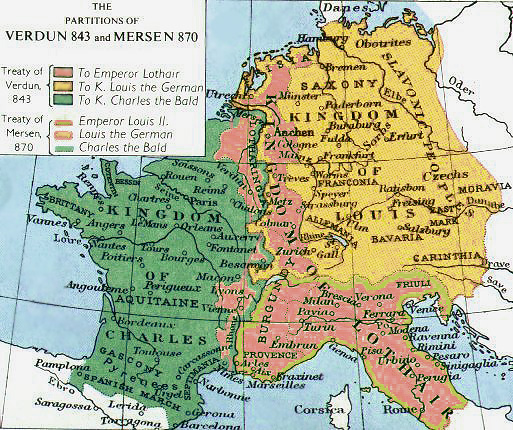
In 840, Charlemagne's only surviving son, Louis the Pious, passed away. His eldest son, Lothair, was to inherit the empire. However, the Frankish tradition was to divide the land between the male heirs, and Lothair's brothers Charles and Louis, claimed their part. After 3 years of internecine conflict, Lothair was forced to cede two thirds of the empire. Charles the Bald inherited Western Francia, which would become known simply as France. Louis the German received East Francia, making up most of present-day Germany. Lothair kept the title of emperor (which is indivisible), but his domain was now restricted to Middle Francia, a strip of land covering the present-day Benelux, Rhineland, Alsace, Lorraine, Burgundy, Switzerland, Provence, and the northern half of Italy as far as Rome.
Middle Francia, also known as Lotharingia, encompassed the old Frankish homeland, Clovis' original kingdom, where the Imperial capital of Aachen was located. It is due to this symbolic value of Old Francia and Rome that Lothair kept this oddly shaped territory for himself.
After Lothair's death in 855, his realm was split again between his three sons. The eldest, Lothair II, inherited the Kingdom of Lotharingia, which was now geographically limited to Alsace, Lorraine and the Low Countries, his brothers inheriting everything from Burgundy to Italy. In 870, a year after Lothair II's death, Charles the Bald and Louis the German obtained the leftovers of Lotharingia, most of which actually acquired by Louis. Owing to the fact that the original Frankish homeland was now being held by the rulers of East Francia, the Imperial crown was allowed to return to Germany, under the rule of Otto I (912-973).
Whoever ruled over the Low Countries could claim the Imperial crown. It is by the same logic that the Habsburgs of Austria later monopolised the title of emperor. Between the rule of Charlemagne (800-814) until the Habsburg emperor, 16 out of the 28 Holy Roman Emperors were of Frankish descent (Carolingian, Salian Frankish, and Luxembourg dynasties).
The first Habsburg to be elected as Holy Roman Emperor was Frederick III in 1440, who married the only daughter and heiress of Emperor Sigismund of Luxembourg. The House of Luxembourg, although originating from a tiny duchy, had the prestige of ruling over a section of the original Frankish Kingdom, and had three of their members elected as emperors. By marrying into the House of Luxembourg, the Habsburgs increased their own prestige and could be seen as having inherited the title of emperor. To consoladiate this prestige, the second Habsburg emperor, Maximilian I, married Mary of Burgundy, sole heiress of the Duchy of Burgundy and most of the Low Countries (all but the Prince-Bishopric of Liège). Now ruling directly over practically all the original Frankish homeland, and marrying the descendants of Charlemagne himself, the Habsburgs became seen as the legimiate heirs of Charlemagne and were allowed to remain Holy Roman Emperor until the dissolution of the empire in 1806.
The Low Countries and the German Rhineland were annexed by France in 1792. With France now in possession of the Frankish homeland for the first time in its history, there only needed a new monarch to claim the title of emperor. When Napoleon did it by proclaiming himself emperor and heir of Charlemagne (see below) in 1804, the Habsburgs, who saw themselves as the sole legitimate heirs of the Franks, created the title of Emperor of Austria the same year.
Establishing the European nobility
The European nobility, born in the Middle Ages and surviving to this day, has its roots in the Frankish nobility system. The Franks were in fact the first to use the Latin titles of dux (duke) and comes (count) to mean "feudal lord" ruling over a duchy or county. The Romans did not have any duchies or counties. For the Romans, a dux was merely a "military leader", while comes meant "imperial companion", such as courtiers and provincial officials. The Franks used these terms for the military rulers of their provinces, who later became sovereign rulers after the parcelling of the Carolingian Empire.
In the Carolingian era, a new title was created for the military governors of a March (from the Old Frankish marka, meaning "border"). This title was that of Markgrave (from German Markgraf, "border count"), which would later become Marquis in French and in American English, then Marquess in British English.
As the European population grew and fiefs multiplied, a need for lower titles emerged. The French coined the name of vicomte ("vice + count"), which would be rendered into English as Viscount, while in German and Dutch speaking areas the title just under that of Count (Graf in German) became that of Burggraf or Burggraaf (literally "Town Count").
The Frankish word baro ("freeman") evolved to mean "nobleman" (as opposed to peasants, who were serfs). It became the title of Baron, which took the lowest place in the hierarchy of the titled nobility. Knight was not originally a title, but a sort of "occupation". Not all nobles were knights, as not all fought in battles. From the 17th century, when the time of feudal warfare and chivalry came to an end, knighthood became a form of gentility in countries like England, and developed into a title of its own in other countries like France.
Napoleon Bonaparte, heir of the Franks
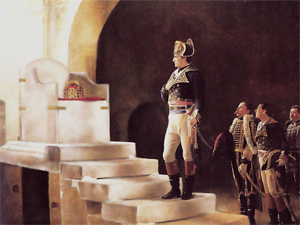
Napoleon Bonaparte often compared himself to Charlemagne and wanted to be seen as the heir of the Frankish kings and emperors. He went on a "pilgrimage" to Aachen shortly before becoming emperor, to pay homage to his role model and see his legendary crown and sword.
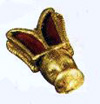
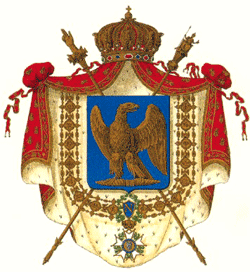
When he became emperor, Napoleon long hesitated between the bee and the eagle for his coat of arms and symbol of his empire. The bee was the symbol of the Merovingian kings, and 300 golden bees were also found in the tomb of King Childeric I (Clovis's father) in Tournai. Napoleon was well aware of this. The eagle was the symbol of the Holy Roman Empire, to mark the continuity with Ancient Rome. Eventually, Napoleon opted for the eagle to represent his empire, but integrated golden bees on the imperial coat.
Birth of the French language
Belgium, the Frankish homeland
The kingdom of France, the Holy Roman Empire of the German Nation (later Germany), and the Grand Duchy of Luxembourg all have Frankish origins in their foundations.
Belgium was not founded as a modern, unified state until 1830, mostly because of was a key component of the Empire before that, the Frankish homeland which possession justified and legitimised the title of emperor. It is therefore less obvious that Belgium is the sole nation (along with Luxembourg) where the whole indigenous population can claim to descend in great part from the Franks. Modern genetic studies have determined that over half of all Belgian paternal lineages are of Germanic origin, which in Belgium's case means almost exclusively of Frankish origin.
Modern Belgium owes its name to the ancient Gallia Belgica, which, at the time of the conquest of Julius Caesar, comprised today's country as well as the south of the present Netherlands, the modern French regions of Nord-Pas-de-Calais, Picardy, Champagne-Ardennes, Lorraine, Alsace, as well as the German Rhineland. Gallia Belgica was quickly subdivided in 3 provinces, and modern Belgium was renamed Germania Inferior, along with the northern Rhineland and the southern Netherlands, with the Rhine marking the outer border of the Roman Empire.
It is in Germania Inferior that Salian Franks settled in the late 3rd century, and this region corresponds roughly to the original Merovingian kingdom that Clovis inherited. The capital of the Merovingians until Clovis was Tournai, at the western extremity of present-day Wallonia, while the political centre of the Carolingians was in Liège, in eastern Wallonia. Wallonia was thus the very heart of the Merovingian and Carolingian homeland, and the two Frankish capitals mark its historical boundaries. Most of the Walloon population lives along the Sambre-Meuse axis between Tournai and Liège. Despite the fact the Walloons are now French speakers, their DNA is much closer to that of the Flemings than to the French average.
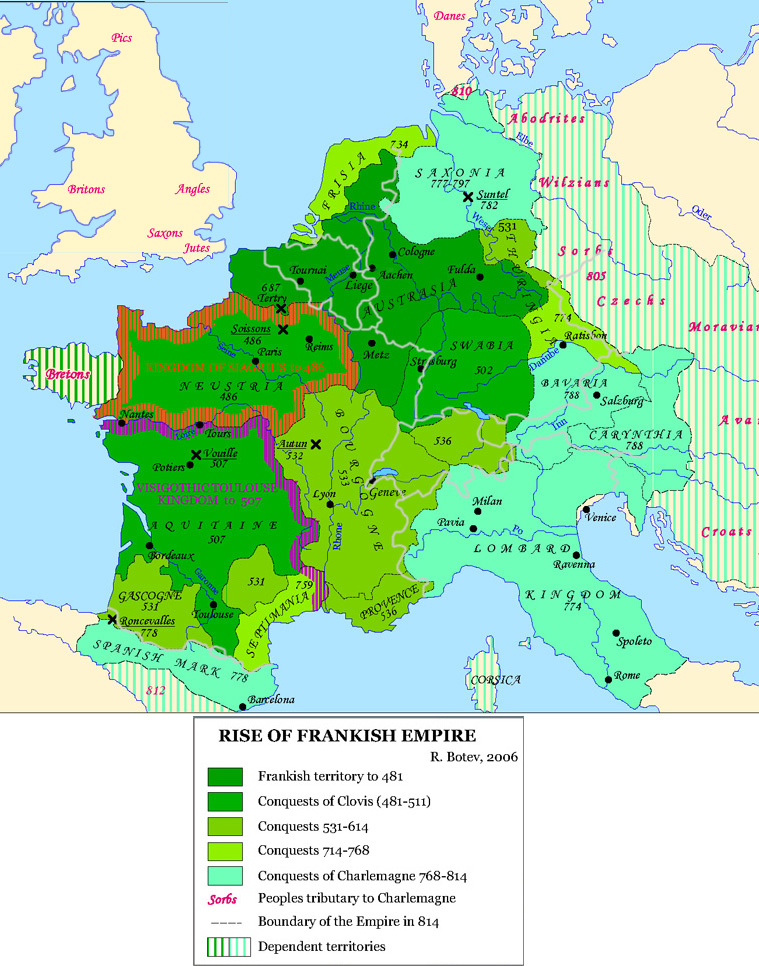
Wallonia, the base of the Frankish court, birthplace of the French language
It may be surprising that Wallonia and Northern France (Nord-Pas-de-Calais, Picardie) is the only part of the original Frankish kingdom where a Romance language is now spoken, and not one descended from Old Frankish, like in Flanders or the Rhineland. What is more, Wallonia has never belonged to France in its history (apart from 26 years during the French Revolution, like most of Europe), and the Nord department of France did not belong to France until Louis XIV's conquest in the late 17th century, eventhough the southern half of the region was already French-speaking. So the presence of the French language in Wallonia can only predate the creation of the Kingdom of France in 843.
It is known that the Salian Franks (at least the nobility) spoke Latin since the 4th century, at the time when they settled in the Roman Empire. The Merovingian ruling class continued to use Latin, as they considered themselves the heirs of the Romans (after providing many Roman generals, consuls and senators in the fourth century).
French language developed as a corrupted version of the Latin spoken by the Franks, which evolved further away from the original Latin after the fall of the Roman Empire. This is why French pronunciation is so different from other Romance languages, and includes many sounds typically found in Germanic languages, like the French "eu" (written "ö" or "ø" in most Germanic languages), the "u" ("ü" or "y"), the "e" (the schwa), the "è" ("ä"), or the short "o" ("å" in Scandinavian languages and in Walloon).
However, not all the Frankish tribes spoke Latin, only the Salian and Mosan Franks did, as they were the only ones to live within the Empire. Wallonia and the northern tip of France became Francophone because they lied at the political centre of the Frankish monarchy, where Latin was predominant. However, the rest of the Frankish population, the peasants far from the court, did not adopt Latin. This explains that Germanic languages descended from Old Frankish (e.g. Dutch, Flemish, Franconian German) are still spoken in most of the old Frankish territory.
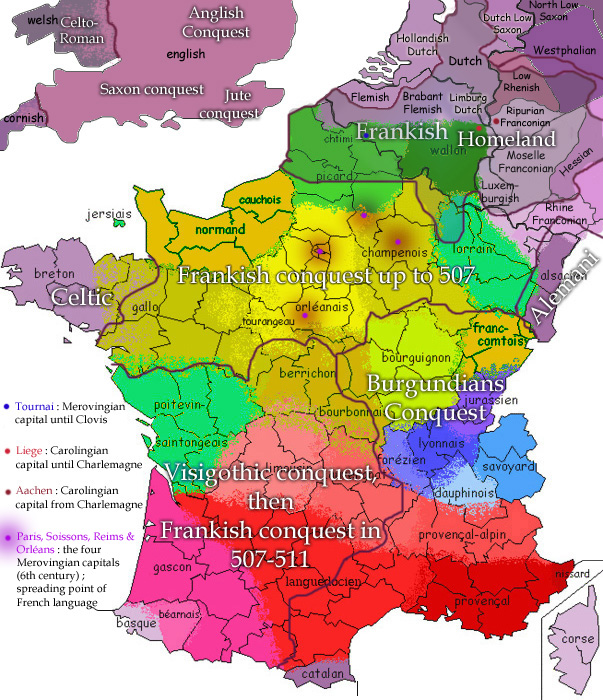
Clovis moved his capital to Paris after conquering Roman Gaul. His kingdom was then split between his four sons, respectively based in Paris, Orléans, Soissons, and Reims, i.e. the regions of France where the langue d'oil (direct ancestor of modern French) originated (=> langue d'oil regions are indicated in yellow and green on the map of French dialects below).
The second wave of Frankish rulers, the Carolingians, originated in Eastern Wallonia, just at the present linguistic border between French, German and Dutch. Linguists know that it is where there is the greatest linguistic diversity in modern ttimes that a language originated. This triangle Liège-Aachen-Maastricht represent the political core of Charlemagne's Empire, and these cities now speaks respectively French/Walloon, German/Ripuarian Franconian, and Dutch/Limburgish, and yet they are only 40km from each others. The linguistic border is actually within the borders of the province of Liège. Although most of the province is French-speaking nowadays, the north of the province is Dutch-speaking (the "Fourons" or "Voeren"), and the eastern part makes up the German-speaking (Ripuarian Franconian dialect) community of Belgium.
In the same way, since the Norman conquest in 1066 until the 14th century, the English aristocracy spoke French while the populace spoke Middle English (a close cousin of Frisian, Frankish and Saxon languages). The difference is that the two languages eventually merged in England because of intermarriages and closer contact between the nobility and the rest of the population, while on the continent the elite of almost every country continued to speak French until the mid-20th century - as far as away as Russia and the Ottoman Empire, where French was the language of the Upper Classes ! Wallonia and northern France (green areas on the map below) became predominantly French-speaking because they were the first region were Vulgar Latin/Old French became spoken widely within the Frankish lands, due to the high density of Frankish noblemen, and children (legitimate or not) of Frankish monarchs.
Frankish culture
The Salic Law
The terms "Salian" or "Salic" itself comes from the ancient town of Sala, now Overijse in Flemish Brabant, just south-east of Brussels.
The so-called Salic law (Pactus legis salicae in Latin), was modelled on the Roman Law and incorporated elements of Frankish traditions. It was codified during the reign of Clovis I, regulated such matters as inheritance, crime, and murder. It forbid, for example, a throne to be passed to a female heir or through female line. It influenced the sucession practices in France and in some German states (e.g. Hannover).
The application of the Salic Law determined the sucession of John I of France in 1316, and was later contested by the allied Kings of Navarre and England. It was the cause of the Hundred's Years War (1339-1450) between France and England.
Britain only adopted the Salic law from George I (1660-1727), who was German. Upon the death of the last Hanoverian ruler, King William IV (1765-1837), the Salic law was scraped, and his niece Victoria ascended the throne of Great Britain and Ireland.
Frankish people in Germanic paganism and Romantic literature
Two operas of Richard Wagner were inspired by the Frankish court : Lohengrin and Siegfried (part of The Ring of the Nibelung).
Lohengrin, the son of Percival, was a knight of the Holy Grail, an order which members are sent out in secret to provide lords to kingdoms that have lost their protectors. Upon the death of the Duke of Brabant, Lohengrin is sent in a boat pulled by swans to rescue Princess Elsa of Brabant, and marries the Duchess. The "Bridal Chorus" ("Here Comes the Bride") in Wagner's opera is the standard march played for the bride's entrance at most formal weddings in the Western world.
Siegfried is one of the most famous Germanic heroes, the dragon-slaying hero in the Nibelungenlied. After killing the dragon, he bathed in its blood, rendering him invulnerable. Unfortunately for Siegfried, a leaf fell from a linden tree above while he is bathing and landed on his back, and the tiny patch of skin that it covered did not come into contact with the dragon's blood, and he was eventually killed by Hagen (or by Odin in Wagner's opera). Siegfried is the equivalent of 'Achilles' in Greek literature. In Wagner's opera, Siegfried had married the valkyrie Brünnhilde. The couple was clearly inspired by Merovingian king Sigebert I (Clovis' grandson) and his wife Brunhilda of Austrasia.
Christian Saints of Frankish blood
Numerous people canonised by the Roman Catholic Church belonged to the Frankish ethnicity. This is still obvious nowadays by the names of saints given to churches in the Low countries, where the Franks settled. Here are a few famous ones :
Words of Frankish origin (3rd to 6th century)
The influence of the Franks has survived in modern English, French, Italian, Spanish and Portuguese languages. There are only about 800 words of Frankish origin in modern French, but this includes many very common words.
- (g)want : gauntlet (gant in French, guante in Spanish)
- stakka : to detach (détacher in French, destacar in Spanish)
- standhard : standard (standard in French, estandarte in Spanish)
- laubja : (to) lodge (loge(r) in French, loja, alojar in Spanish)
- skirmjan : skirmish (escarmouche in French)
- scoc : (to) shock (choc, choquer in French)
- warding : guard, guardian, warden (guarde, guardien in French)
- werra : war (guerre in French, guerra in Italian, Spanish and Portuguese)
- sakjan ("lay claim to") : seize (saisir in French)
- bannjan : abandon (abandonner in French, abbandonare in Italian), bandit (bandit in French, bandito in Italian and Spanish)
- warand : warrant (guarant in French)
- hring : rank (rang in French, rango in Italian and Spanish)
- baro (freeman, warrior): Baron
- marhskalk ("horse-servant") : marshal (maréchal in French, maresciallo in Italian, mariscal in Spanish)
- marka : (to) march (marche, marcher in French) / border, boundary
- bord : border (bordure in French)
- rant ("a running") : random (randonnée in French)
- trotton ("to tread") : (to) trot (trot, trotter in French, trotto in Italian, trotar in Spanish)
- walalaupan ("to leap well") : (to) gallop (galop, galoper in French)
- graper : grape (grappe in French)
- bera : beer (bière in French, birra in Italian)
- wostjan : waste (gaspiller, gaspillage in French)
- skarberg : scabbard
- stal : stale, stall (étale, étalage, étable in French)
Frankish given names
To get a better idea of what the Frankish culture was like, here is a list of given names of pure Frankish (or at least Germanic) origin. From Charlemagne onwards the names became more and more Christianised.
Male names : 5th to 10th century
Abbo, Adalard, Adalberon, Adalbert, Adaldag, Adalhaid, Adalhard (or Adelard), Adalolf, Adelelm, Aega, Ageric, Agilbert, Agilfride, Agiulf (or Aigulf), Agobard, Alberic, Allowin, Altmar, Amalbert, Amalric (or Amalricus), Amand, Amator, Andica, Angegisis, Angilbert (or Engilbert or Angilbart), Anno, Ansegisel, Anskar, Ansovald, Aregisel, Arbitio, Arbogast (or Arbogastes), Arculf, Arnegisel, Arnold (or Arnoul), Arnulf, Artaud, Asselin, Atacinus, Audoen, Audomar, Audoneus, Audovald, Audramnus, Austregisel, Badegisel, Balderic (or Baldrick), Baudry, Baugulf, Bauto, Bavo, Benild, Berchar, Berengar (or Berenger), Bernhard (or Bernard), Berno, Bero, Bertelis, Berthaire, Berthefried, Bertin, Bertram, Bertulf, Besso, Birinus, Blutmund, Bodilo, Boso, Burchard, Brocard, Burchard, Butilin, Carloman (or Karlmann), Cassyon, Ceolfrid (or Ceufroy or Ceolfridus), Chararic, Charibert, Cheldric, Childebert, Childebrand, Childeric, Chilperic, Chlodomer (or Choldmer), Chlodowig, (or Chlodwig or Clovis), Chlotar (or Clothair or Clotaire), Chrodegang, Clodomir, Chramnesind, Chunibert, Clodio (or Chlodion), Cloud, Conrad, Corbinian, Corbus, Dado, Dagobert, Dagaric, Dalfin, Drogo (or Drogon), Dudon, Durand, Eberhard (or Evrard), Ebbo, Eberulf, Ebregisel, Ebroin, Ebrulf, Ecfrid, Einhard, Emebert, Emme, Emmeran, Emmon, Engilbert (or Engelbert), Egide, Eracle, Erard, Erchinoald, Erenfried, Euric, Evroul (or Evroult), Farabert, Fardulf, Faro, Flodoard, Floribert, Folcard, Folmar, Fredegar, Fridolin, Fridugis, Fulbert, Fulcaire, Fulk, Fulrad, Gararic, Garivald, Gerbert, Gereon, Gerold, Gifemund, Giselbert (or Gilbert), Giseler, Giso, Godobald, Godomar, Godun, Goisfrid, Gondulph, Goscelin, Gozbert, Gozolon, Grimbald, Grimald (or Grimoald), Grifo (or Griffon), Guido (or Wido), Gundobad, Gundovald, Gunthar, Guntram, Hagen, Halinard, Hardrad, Hartgard, Hartmut, Hartnid, Helinand, Helisachar, Heribert, Hildebald, Hildebold, Hildeprand, Hilduin, Hincmar, Hlodver, Hrodbert (later Robert), Hruoland (later Roland), Hubert, Huebald, Humbert, Hunald, Imbert, Imninon, Imnachar, Ingelram (later Enguerrand), Ingobert, Ingomer, Ingund, Jocelin (or Josselyn), Lambert, Lanfranc, Laudus, Lebuin, Ledger, Leger, Leodegar, Leudast, Leufrid (or Leutfred or Leufroy), Leuthard (or Letard or Leuthere), Liudhard, Liudolf, Lo, Lothar, Lull (or Lul), Maiuel, Maixent, Magnachar, Magneric, Malaric, Mallobaudes, Marachar, Maraulf, Marcomir, Matfrid, Mauger, Medard, Meginhard, Merobaudes, Merovech, Monulph, Munderic, Nevelung, Nibelung, Nithard, Notger, Norbert (or Nordbert), Notker, Odalric, Odilon, Odo (Eudes), Odulf, Omer, Otbert, Otker, Otto (or Otton), Otker, Ouen, Philibert, Pippin (or Pepin), Priarios, Radigis, Ragnachar, Ragnfred, Ramnulf, Rathar, Rathier, Ratold, Reginar (or Reginard), Remacle, Ricbodo, Ricchar (or Richer), Ricfried, Richomer, Rigunth, Rothad, Samson, Sichar, Siegfried (or Sigefroy), Sigeric, Sigibert (or Sigebert), Sigismund, Suger, Suidbert, Suidger, Sunnegisil, Sunno, Tassilo, Tescelin, Teutfride, Thankmar, Theodard, Theodebert, Theodemir, Theodon, Theodoric (later Dietrich/Thierry/Theodore), Theodulf (or Theodulph), Theodwin, Theudebald, Theudebert, Theuderic, Theutgaud, Thietmar, Turpin, Unroch, Vedast, Vicelin, Vigor, Vulmar, Waiofar, Wala, Walaric, Waleran, Walcaud, Waldolanus, Waltgaud, Wandregisel (or Wandregisilus), Wandrille, Warmann, Wazo, Werinbert, Wibert, Wichmann, Willehad, Willibald, Willibrord, Willichar, Wolbodo, Wulfhard, Wulfram, Zwentibold.
Male names : 11th to 16th century
Adalbert, Albert, Ameil, Anselme, Arnaud, Arnold (or Arnould), Arnulf, Baudouin, Bernard, Bertrand, Englebert, Erard, Ernest, Ernut, Erwin, Eubert, Eude, Evrard, Frederic, Gerard, Geoffroy, Gilles, Giselbert, Gobert, Godefroid (or Godfroy, Godfried, Gottfried, Godfred), Guillaume, Guy, Henri, Huart, Hubert, Hubin, Hubinet, Humbert, Huwes, Josse, Lambert, Léonard, Libert, Louis, Oger, Olivier, Ottar(d), Ottekin, Otton (or Othon), Oury, Raes, Raoul, Rasse, Rasson, Raymond, Reginar, Renard, Renaud, Rennechon, Renier, Richard, Rigaud (or Rigault), Robert, Roger, Roland, Rudolf, Ruward, Soiffart, Thibaut, Thierry, Waléran, Walter, Warnier, Wauthier (later Gauthier)
Female names
Adaltrude, Adallind(a), Adelhaid (or Adelheid), Adda, Albofleda, Alpaide (or Alpais, Alpaida, Elfide, Chalpaida), Ansgard, Aregund, Aubirge, Aude (or Oda), Audofleda, Audovera, Austrechild, Atula (or Athalia or Adele) Baldechildis, Basina, Bave, Berchildis, Begga, Berenga, Beretrude, Berga, Bertha (or Berthe), Berthefled, Berthefried, Berthegund, Bertoane, Bertrada, Bilichildis, Blesinde, Brunhild(a), Burgundefara, Chlodeswinthe, Chlodosind, Chlothsinda, Chrodechildis, Chrodtrude, Clotild(e), Chunsina, Cunegonde (or Kunegund or Cunegundis or Cunegund) , Deuteria, Ealswid, Eadgithu, Ellinrat, Engelberge (or Ingelburga or Engelberga), Engeltrude, Ermenberga, Ermengard(e), Ermentrudis, Faileuba, Fara, Fastrada, Fredegunde, Galswinth, Genofeva, Gerberga, Gersvinda, Gisela, Gundrada (or Gundradis), Gomatrudis, Goiswinth, Gundrade, Guntheuc, Gunza, Hamesindis, Hatilde, Herleva, Hildeburg, Hildegard(e), Hildegund, Hiltrude, Himiltrud, Hodierna, Ingeltrud, Ingitrude, Ingoberg, Ingunde, Irmgard (or Irmingard), Itta, Joveta, Lanthechilde, Leubast, Leubovera, Liobsynde, Liutgarde (or Luitgarde), Madelgarde, Magnatrude, Marcatrude, Marcovefa, Madelgarde (or Madelgarda), Mechtild (later Mathilde), Merofled, Merwig, Moschia, Nantechildis, Ogiva, Plectrudis, Radegund (or Radogund), Ragnachilde, Regintrude, Regnetrudis, Reineldis, Rigunth, Rosamund, Rotrud (or Hruothraud), Ruodhaid (or Rothaide), Ruothild(e), Rothaide, Rotrude (or Rotrudis), Ruothilde, Swanahilde, Teutberga, Theoderada (or Theodrada), Theodelinda, Theoderada (or Theodrade), Theudechild, Theudelinde, Theutberga, Ultrogotha, Veneranda, Vuldretrada, Vulfegundis, Waldrada, Wisigard.
Female names : 11th to 16th century
Adèle, Adelhaid (later Adélaïde), Adélaïs, Aldegonde, Adylide, Alÿde, Bertha, Bertheline, Ermengarde, Ermesinde, Gertrude, Juwette, Hedwide (or Hadwide), Helwide (or Halwide), Mahaut, Mathilde, Mechtilde, Odile, Otheline, Renewis, Sibille, Walburge