• Don't want to see ads? Install an adblocker like uBlock Origin or use a Europe-based privacy-friendly browser like Vivaldi or Mullvad.

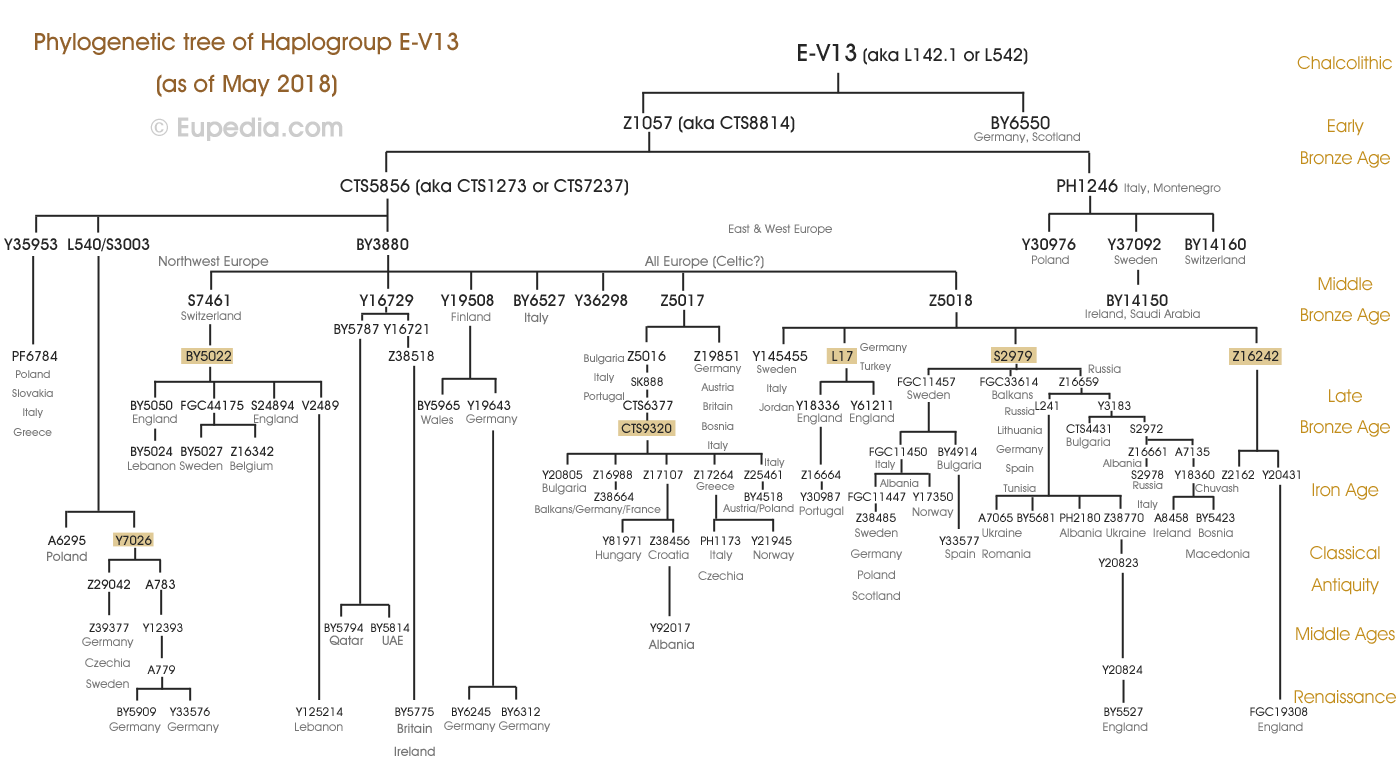
Updated phylogenetic tree of E-V13

Mmm yea that last paragraph makes a lot of sense, i kinda like the thracian idea too. But yeah two coastal adriatic results as the only archaeological finds is wild considering where all this line ended up. Gonna buy some books on the Mediterranean and Balkan metal ages and hopefully more dna pops up sooner than later, very intrigued now.

Thanks again !

Edit: just realized the trogir is a newborn baby, that’s insane to think about

Another edit sorry, is there a way to get my results on yfull without the subclade listed on there or do i have to wait until more tests come back ?
Hi mate

I am also paternally Deep Maniot (J2a though) and intrigued by your results. Do you know more about your paternal line. For example the paternal village’s name in Eastern Mani?
 
Hi mate

I am also paternally Deep Maniot (J2a though) and intrigued by your results. Do you know more about your paternal line. For example the paternal village’s name in Eastern Mani?
Yea! My great grandpa was from Chimara and my great grandma was from Gonea both outside of Kotronas. My great grandma was Cretan though. They immigrated with my grandpa and since then my families been in the states. We didn’t get the chance to test my grandpas autosomal, i would have loved to see it. But based on dads and his siblings it would have been close to 100% greek if not 100% (only one of my grandpas kids got 1% balkans and the only other mediterannean was 2% Cypriot). What town are yall from ? Also do you want to know the surnames ?

Edit: 100 percent Greek as in mainland + islands
 
Last edited:
YFull assigns to according to your results and the available samples on your branch. Like my own result is much less refined on YFull, since much less people have uploaded there than there are FTDNA branch members.

On second thought, its also possible that if your branch was South Thracian, it could have migrated earlier with Greeks and Romans still, over the sea, than those which might have come in later, like those from the Danube and North of it.
Also, your branch while relatively small is still diverse enoughf or allowing subbranches having gone different routes early on.
THE SEA PEOPLES RAHHH. Just kidding obvs but having formed ~1200 years ago it makes it hard to see the migrations until the Greco-Roman days, again gonna dig into the books. I think there’s either a layered, slow migration or a multifaceted migration around the Black Sea or carpathian basin as that’s the only way i can think of it spreading out in multiple directions with varying clades like it did (obviously spread through seafaring too with the greco-romans). Migrating from there to south Thrace and then staying in a community for a while before making its way over to the peloponnese does make sense. I’ll update with anything relevant i find in the books !

Edit sorry for the new account i had two emails on here and signed in with the other one my bad hahah
 
Last edited:
THE SEA PEOPLES RAHHH. Just kidding obvs but having formed ~1200 years ago it makes it hard to see the migrations until the Greco-Roman days, again gonna dig into the books. I think there’s either a layered, slow migration or a multifaceted migration around the Black Sea or carpathian basin as that’s the only way i can think of it spreading out in multiple directions with varying clades like it did (obviously spread through seafaring too with the greco-romans). Migrating from there to south Thrace and then staying in a community for a while before making its way over to the peloponnese does make sense. I’ll update with anything relevant i find in the books !

Edit sorry for the new account i had two emails on here and signed in with the other one my bad hahah
only using the 77 acct from now on btw sorry about that😭😭

Also, could a group like the catacomb culture be how e-v13 potentially got down to Thrace (assuming Thrace is right for the sake of argument) ? E-by3880 spread throughout Europe and the steppe via catacombs. An IE got to Thrace maybe via a multi cordoned ware connection and then stayed there. Then in the dark ages and reemergence of Greek civilization it spread enough to then end up in Croatia and the Peloponnese? Just spitballing and this is assuming a southeastern Europe/thracian connection.
 
Catacomb culture was largely steppe and Yamnaya derived, rather not.

I think that Cotofeni might have been the main spreader of E-V13 in the earliest period, or better it survived in Cotofeni, because at that time E-V13 was a very small male lineage still. It began to grow only later, in my opinion within Nyirseg and into Eastern Otomani, from there on Suciu de Sus and related groups which created the Gáva/Channelled Ware horizon.
 
In the Hungarian conference "Tranformation of Europe in the 3rd Millennium BC", they had a presentation for Cotofeni, in the Day 2 video(first presentation of Day 2). They were quite clear that Cotofeni people survived, as for DNA samples the speaker replied that we have to wait until the Transylvania paper is published. Now we wait and be tormented.
 
Catacomb culture was largely steppe and Yamnaya derived, rather not.

I think that Cotofeni might have been the main spreader of E-V13 in the earliest period, or better it survived in Cotofeni, because at that time E-V13 was a very small male lineage still. It began to grow only later, in my opinion within Nyirseg and into Eastern Otomani, from there on Suciu de Sus and related groups which created the Gáva/Channelled Ware horizon.
Ahhhh. I’m picking up “the horse the wheel and language”, the “lost world of old Europe: the Danube valley 5000-3500 bce”, “the dark ages of greece”, “the late copper age coțofeni culture of south east Europe”, and “the end of the Bronze Age”. Gonna try to tear thru them i need to get my knowledge levels elevated hahah
 
Hi Maciamo, this is an amazing job you're doing!


I have a question regarding PH1246 - branch of E-V13 that is for some reason not being talked at all on this forum. PH1246 > BY14151 was not included into your tree and that is a branch present only in Serb-Montenegrin clan of Vasojevici, as well as Bobani clan of East Herzegovina (Vasojevici claim Herzegovina origin so these are clearly related). But Vasojevici are not related to any other E-V13 populations living just next to them. For example Bjelopavlici (Serb-Montenegrins) and Kelmendi (Albanians) are E-V13>Z1057>CTS5856>BY3380>Z5017>Z5016>Y3762>CTS6377>CTS9320>Z16988 and Kuci (Serb-Montenegrins) are E-V13>Z1057>CTS5856>BY3380>Z5018>S2979>Z16659>Y3183>S2972>Z16661. So Vasojevici, being not a CTS5856 but a PH1246 branch, have a common ancestor with these neighboring clans that is 4,5 thousand years old!


How is that possible? Any explanation for this?
Also, doesn't this very distant relation of E-V13 clans living next to each other confirm Balkan origin of E-V13?


Thanks again!
Interesting I have never heard of any of that although I have only been doing the Y DNA thing for 5 years. There was a recent discovery made is that my E-CTS2001 branches directly off of E-SK888 I'm confirmed negative for E-CTS6377. I was told that it appears to be of Carpathian Origins?Once Dr. Imre findings are implemented will I still belong to Haplogroup E-Z16988?
 
Ho aggiornato e ampliato l'albero filogenetico dell'aplogruppo E-V13. Ho modificato il layout per mostrare quando ogni clade si è sviluppato nel tempo, in modo da avere un'idea migliore di quando si sono verificate le espansioni regionali.

Molti rami dell'albero sono ancora mancanti. Ci sono pochi campioni greci, italiani, francesi e iberici testati per cladi profondi e quasi nessuno dell'Asia occidentale, fatta eccezione per gli stati del Golfo.

Cliccando sull'albero si accede alla pagina esterna al forum e cliccando ancora una volta si visualizza lo schermo intero.

Ho aggiornato e ampliato l'albero filogenetico dell'aplogruppo E-V13. Ho modificato il layout per mostrare quando ogni clade si è sviluppato nel tempo, in modo da avere un'idea migliore di quando si sono verificate le espansioni regionali.

Molti rami dell'albero sono ancora mancanti. Ci sono pochi campioni greci, italiani, francesi e iberici testati per cladi profondi e quasi nessuno dell'Asia occidentale, fatta eccezione per gli stati del Golfo.

Cliccando sull'albero si accede alla pagina esterna al forum e cliccando ancora una volta si visualizza a schermo intero.
L'aplogruppo y 16729 dovrebbe essere aggiornato. In Italia siamo ora in 4. Poi ci sono anche Grecia, Macedonia e Croazia
 
Ho aggiornato e ampliato l'albero filogenetico dell'aplogruppo E-V13. Ho modificato il layout per mostrare quando ogni clade si è sviluppato nel tempo, in modo da avere un'idea migliore di quando si sono verificate le espansioni regionali.

Molti rami dell'albero sono ancora mancanti. Ci sono pochi campioni greci, italiani, francesi e iberici testati per cladi profondi e quasi nessuno dell'Asia occidentale, fatta eccezione per gli stati del Golfo.

Cliccando sull'albero si accede alla pagina esterna al forum e cliccando ancora una volta si visualizza lo schermo intero.

Ho aggiornato e ampliato l'albero filogenetico dell'aplogruppo E-V13. Ho modificato il layout per mostrare quando ogni clade si è sviluppato nel tempo, in modo da avere un'idea migliore di quando si sono verificate le espansioni regionali.

Molti rami dell'albero sono ancora mancanti. Ci sono pochi campioni greci, italiani, francesi e iberici testati per cladi profondi e quasi nessuno dell'Asia occidentale, fatta eccezione per gli stati del Golfo.

Cliccando sull'albero si accede alla pagina esterna al forum e cliccando ancora una volta si visualizza lo schermo intero.
L'aplogruppo y 16729 dovrebbe essere aggiornato. In Italia siamo ora in 4. Poi ci sono anche Grecia, Macedonia e Croazia
Ho aggiornato e ampliato l'albero filogenetico dell'aplogruppo E-V13. Ho modificato il layout per mostrare quando ogni clade si è sviluppato nel tempo, in modo da avere un'idea migliore di quando si sono verificate le espansioni regionali.

Molti rami dell'albero sono ancora mancanti. Ci sono pochi campioni greci, italiani, francesi e iberici testati per cladi profondi e quasi nessuno dell'Asia occidentale, fatta eccezione per gli stati del Golfo.

Cliccando sull'albero si accede alla pagina esterna al forum e cliccando ancora una volta si visualizza lo schermo intero.

Grazie!

Sì ~1200 a.C. è un periodo molto interessante per avere un LCA. Il by3880 è finito apparentemente ovunque nei registri archeologici su ftdna e anche sull'albero yfull, e poi la linea y16729 è divisa tra Europa e Medio Oriente su yfull, e poi il mio sottoclade è in Germania, Italia, due paesi privati e io in America (il mio sottoclade non è ancora nemmeno su yfull). Non lo so, è molto interessante e un po' misterioso, ho difficoltà a fare ricerche. Ho 27 varianti private e posso condividere i risultati str se questo può aiutare in qualcosa. Inoltre, sto leggendo molti thread su questa roba al momento, siete pazzi con la conoscenza del DNA hahahah
Ciao,e' possibile leggere i tuoi Str .Sono anch'io y16729 .Abito in Italia e la mia famiglia ha origine da Varsi dove erano presenti già nel 1300.In famiglia si e' sempre detto siamo di origine greca.Infatti il mio cognome antico era Perachis.Sto aspettando i risultati per big Y.
 
Ciao a tutti,finalmente sono arrivati anche i miei risultati di bigySono come dskos77 E-FT64983.C'e' però qualche discrepanza perché FTDNA lo fa' nascere in Germania così come Ey16729 in nord Italia.dskos77 dovrebbe specificare il suo paese di origine (che non compare)per aver una migliore spiegazione dei risultati.Inoltre FTDNA propone un percorso migratorio che non ha riscontro nei vari pareri del forum.Qualcuno più esperto potrebbe dare una migliore interpretazione?Grazie
20250608_132159.jpg
 
The big problem with E-FT64983 is its fairly isolated position. I mean it has nothing between 1800 BC and 1000 BC to work with. It just has a fairly massive expansion phase in the Late Urnfield early Hallstatt period, with lots of descendants, but again, rather unusual for E-V13 branches, they don't have a lot of expansive success afterwards, but end up as being all isolated linegaes after 900 BC.

To me this looks like a late Urnfield dispersion, possibly with a group which mixed with other Carpatho-Balkan groups, like Italo-Celtic/Celtic or Northern Illyrian people along the Middle Danube.

At first glance, cultural formations like the Srem group come to mind. This was a group and area in which Bosut-Basarabi North Thracians/Dacians and early Celts and Northern Illyrians met and mixed:
There is first of all the problem of their chronological position. M. Garašanin, R. Vasić and even this author
are inclined to attribute this phenomenon, conditionally, to the so-called
Srem group (Garašanin 1973, 511, Vasić 1987, 555, Tasić 1992, 9). However,
it is not clear what was its relation to the final phase of the Bosut group,
which must have established certain contacts with newly arrived Celtic
tribes in this area as it is suggested by some finds from Gradina on the
Bosut and the stratigraphy of Gomolava. The problem could be solved if we
take into account the following facts: a) that 100 years had passed between
first contacts of the Celts with autochthonous population in Vojvodina (4 th
century BC) and their permanent settling (3rd century BC) and b) that finds
of the ‘Srem group’ originating from graves or hoards possibly belonged to
the tribal aristocracy from the end of the Bosut-Basarabi complex.

This would explain why they have a regular, signficant growth in the LBA-EIA, like other big V13 branches, but fall behind quite drasticaly afterwards: Because they were cut off from the main E-V13 population and the remains re-distributed among Celts and Illyrians.

First is the appearance of Scythian finds in the Pannonian plain in general
and in the Serbian Danube valley in particular that could indicate the end
of Bosut culture and second is the phenomenon identified as ‘Srem group’
or more precisely the finds dating from the horizon of the Čurug hoard.
Scythian finds, considering their character (weapons, seldom jewelry) and
scattered burials date from the first horizon of the final phase of the Early
Iron Age (acinaces from the vicinity of Vršac, finds from Ritopek, one burial
from Doroslovo near Sombor etc.). From the second, later period, date
representative finds, mostly ornaments, which according to the interpretation
of M. Garašanin, R. Vasić and this author are distinguished as Srem group.
In addition to the decorative objects from the Čurug hoard characteristic
of this group are single finds from burials (?) near Sremska Mitrovica, finds
from Kuzmin, Vučedol (Garašanin 1973, 511 sq., Vasić 1987, 555 sq., Tasić
1992, 7 sq.). According to the generally accepted opinions Srem group was of
short existence, between the end of Bosut group in Srem and more effective
presence of the Celts in the Danube basin especially after their defeat at
Delphi in 279 BC and return in the Serbian Danube valley where they
established their community, which under the name civitas Scordiscorum
existed until the arrival of the Romans in this area.

Source: https://www.researchgate.net/public...of_Early_Iron_Age_in_the_Serbian_Danube_basin

Of course, that's a lot of speculation, but that's, in my opinion, a plausible scenario among others of course. Because one has to explain why this branch was so extremely successful in the LBA-EIA, but not before or afterwards. Being cut off early from the main V13 population and moving along with Eastern Celts and Northern Illyrians, both of which had no good luck in the time periods that followed, would be a good explanation for that pattern.
 
Il grosso problema di E-FT64983 è la sua posizione piuttosto isolata. Voglio dire, non ha nulla tra il 1800 a.C. e il 1000 a.C. su cui lavorare. Ha solo una fase di espansione piuttosto massiccia nel periodo tardo di Urnfield e inizio del periodo di Hallstatt, con molti discendenti, ma, ancora una volta, cosa piuttosto insolita per i rami di E-V13, non hanno avuto molto successo espansivo in seguito, ma finiscono per essere tutti linee isolate dopo il 900 a.C.

A me sembra che si tratti di una dispersione tarda dei campi di urne, probabilmente di un gruppo che si è mescolato con altri gruppi carpato-balcanici, come le popolazioni italo-celtiche/celtiche o illiriche settentrionali lungo il Medio Danubio.

A prima vista, vengono in mente formazioni culturali come il gruppo Srem. Questo era un gruppo e un'area in cui i Traci/Daci settentrionali Bosut-Basarabi, i primi Celti e gli Illiri settentrionali si incontravano e si mescolavano:


Ciò spiegherebbe perché hanno una crescita regolare e significativa nell'LBA-EIA, come altri grandi rami V13, ma poi restano indietro in modo piuttosto drastico: perché sono stati tagliati fuori dalla popolazione principale E-V13 e i resti sono stati ridistribuiti tra Celti e Illiri.


Fonte: https://www.researchgate.net/public...of_Early_Iron_Age_in_the_Serbian_Danube_basin

Certo, si tratta di molte speculazioni, ma a mio parere è uno scenario plausibile tra gli altri. Perché bisogna spiegare perché questo ramo abbia avuto così tanto successo nell'LBA-EIA, ma non prima o dopo. Essere stati tagliati fuori presto dalla popolazione principale di V13 e muoversi insieme ai Celti orientali e agli Illiri settentrionali , entrambi sfortunati nei periodi successivi, sarebbe una buona spiegazione per questo schema.
Cao,sei d'accordo con il percorso migratorio e la nascita geografica degli aplogruppi proposta da FTDNA?L618 dalla Sicilia?By3880 in nord Italia?Quindi poi da lì si espansero ad est sino alla Grecia?In che periodo furono maggioranza tra i Daco Traci?
 
Cao,sei d'accordo con il percorso migratorio e la nascita geografica degli aplogruppi proposta da FTDNA?L618 dalla Sicilia?By3880 in nord Italia?Quindi poi da lì si espansero ad est sino alla Grecia?In che periodo furono maggioranza tra i Daco Traci?

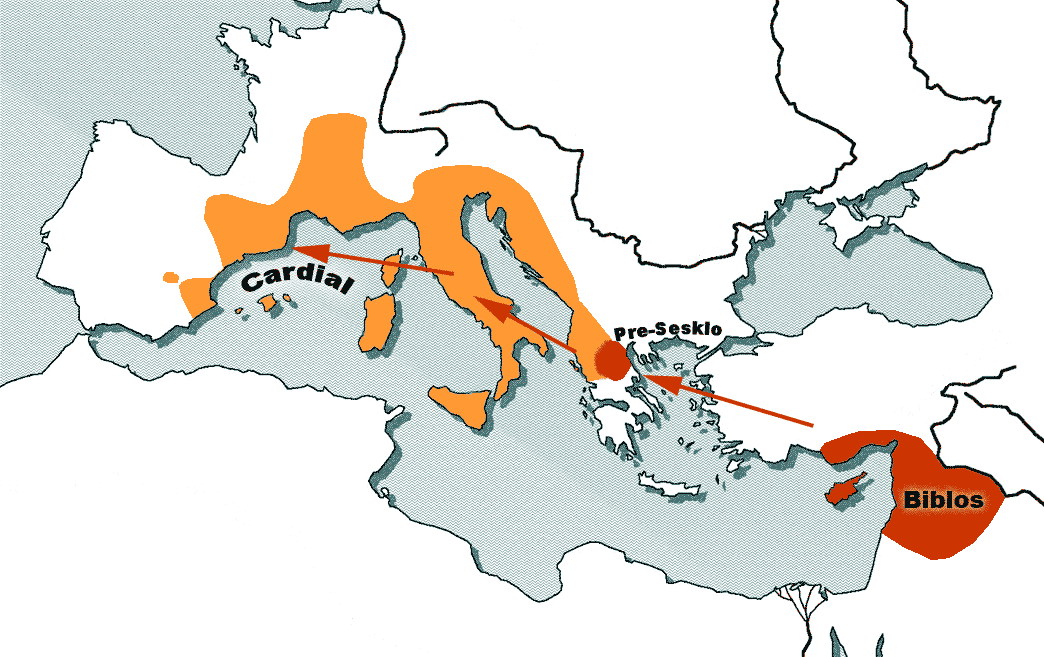
E-L618 spread into Europe with near certainty with Impresso-Cardial Neolithic people:
Cardial_map.png


That's the culture from which we have the first E-L618 finds. Note that one of the earliest, isolated branches, with an ancient DNA sample from coastal Croatia, has now a match with an Iraqi!
This is further evidence for a Levantine route, with an ancestor likely being a Natufian.

The FTDNA interpretation on Globetrekker comes from the fact that E-L618 kind of "jumped" into Europe. The reason for this "leap frogging" is simply that they moved, unlike other early farmers, by sea. First they moved along the coasts into various European coastal regions, then they moved deeper inland along the rivers.

That's how E-L618 spread in groups like Michelsberg, Lengyel, Tiszapolgar-Bodrogkeresztur, Tripolye-Cucuteni, Varna etc.

As for when E-V13 became dominant in Proto-Thracians we don't know, but what we can say for sure is that they totally dominated their (sub-?) population the latest by around 2.000 BC. By 2000 BC the main E-V13 population was fully or nearly fully exclusively E-V13. This implies they had replaced all other haplogroups in their population which might have lived among the Pre-Thracians before.

This is because E-V13 has a specific phylogeny and pattern of growth. This pattern being not mirrored by any other major haplogroup, which implies it is a pattern specific to the Daco-Thracians and specific to E-V13.

That's why E-V13 which don't have the same pattern as the main branches do, kind of stick out. Like most other branches of E-V13 other than E-FT64983, which had such a big success and expansion in the LBA-EIA, did continue to grow and expand later, like e.g. E-CTS9320, E-L241, branches of E-FGC11450.

Whenever a branch has a different pattern, we need an explanation, like in the case of E-FT64983 that it was cut off and not being part of the main Daco-Thracian population after 900 BC.

Because of these fairly strict and specific patterns for the E-V13 main branches, their sheer number and the statistical significance emerging from this number of descendants, we can say that probably already around 2.400 BC, but latest around 2.000 BC, the E-V13 population was totally dominated by this haplogroup.
However, its possible, just possible, which is why I'm careful, that a non-E-V13 Thracian speaking or Para-Thracian population still existed by that time. I don't think this was the case, but if it did exist, it was later nearly completely annihilated by the E-V13 populaton.

After 1.000 BC, after the biggest E-V13 expansion, it is absolutely for sure that Daco-Thracians were completely dominated by E-V13.
 
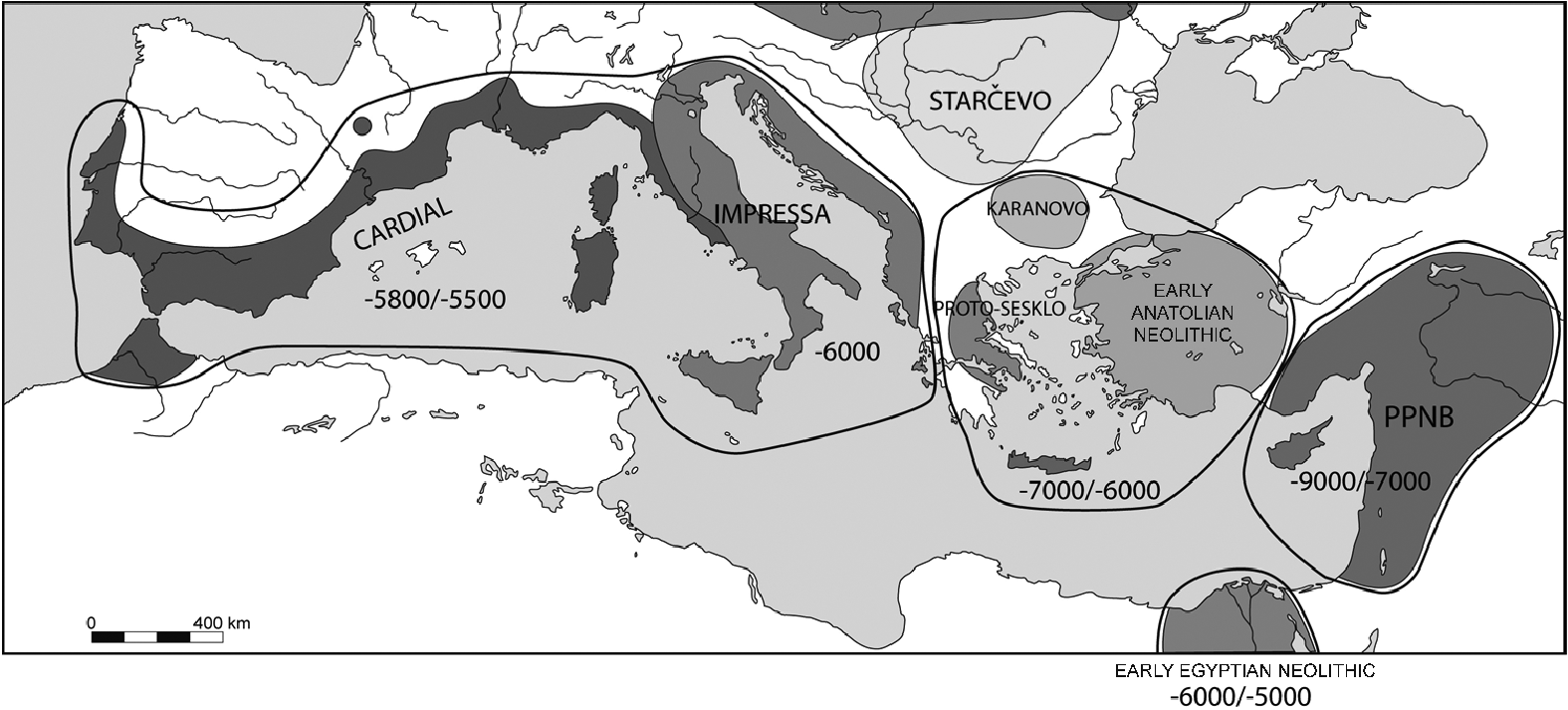
Another map for the spread of Impresso-Cardial and presumably E-L618 (as a minority lineage among them):
urn:cambridge.org:id:binary:20170515105921892-0558:9781316550328:14740fig5_1.png


As you can see, the more likely path is from Pre-Pottery Neolithic in the Levante (post-Natufian) to South Eastern Europe, spreading from there first by sea, along the coastlines, then going into the continent along the rivers in the next step (Lengyel-Sopot etc.).

It is therefore likely they entered Europe via Crete/Greece, and moved to Italy from there, rather than the opposite way around.
 
Il grosso problema di E-FT64983 è la sua posizione piuttosto isolata. Voglio dire, non ha nulla tra il 1800 aC e il 1000 aC su cui lavorare. Ha solo una fase di espansione piuttosto massiccia nel periodo tardo di Urnfield e inizio del periodo di Hallstatt, con molti discendenti, ma, ancora una volta, cosa piuttosto insolita per i rami di E-V13, non hanno avuto molto successo espansivo in seguito, ma finisce per essere tutte linee isolate dopo il 900 aC

A me sembra che si tratti di una dispersione tarda dei campi di urne, probabilmente di un gruppo che si è mescolato con altri gruppi carpato-balcanici, come le popolazioni italo-celtiche/celtiche o illiriche settentrionali lungo il Medio Danubio.

A prima vista, vengono in mente formazioni culturali come il gruppo Srem. Questo era un gruppo e un'area in cui i Traci/Daci settentrionali Bosut-Basarabi, i primi Celti e gli Illiri settentrionali si incontravano e si mescolavano:


Ciò spiegherebbe perché hanno una crescita regolare e significativa nell'LBA-EIA, come altri grandi rami V13, ma poi restano indietro in modo piuttosto drastico: perché sono stati tagliati fuori dalla popolazione principale E-V13 ei resti sono stati ridistribuiti tra Celti e Illiri.


Fonte: https://www.researchgate.net/public...of_Early_Iron_Age_in_the_Serbian_Danube_basin

Certo, si tratta di molte speculazioni, ma il mio parere è uno scenario plausibile tra gli altri. Perché bisogna spiegare perché questo ramo ha avuto così tanto successo nell'LBA-EIA, ma non prima o dopo. Essere stati tagliati fuori presto dalla popolazione principale di V13 e muoversi insieme ai Celti orientali e agli Illiri settentrionali , entrambi sfortunati nei periodi successivi, sarebbe una buona spiegazione per questo schema.
Cao,sei d'accordo con il percorso migratorio e la nascita geografica degli aplogruppi proposta da FTDNA?L618 dalla Sicilia?By3880 in nord Italia?Quindi poi da lì si espansero ad est sino alla Grecia?In che periodo furono maggioranza tra i Daco Traci?
Un'altra mappa per la diffusione di Impresso-Cardial e presumibilmente di E-L618 (come lignaggio minoritario tra loro):
urn:cambridge.org:id:binary:20170515105921892-0558:9781316550328:14740fig5_1.png


Come si può vedere, il percorso più probabile va dal Neolitico preceramico nel Levante (post-natufiano) all'Europa sudorientale, diffondendosi da lì prima via mare, lungo le coste, per poi addentrarsi nel continente lungo i fiumi nella fase successiva (Lengyel-Sopot ecc.).

È quindi probabile che siano entrati in Europa attraverso Creta/Grecia e da lì si siano spostati in Italia, piuttosto che il contrario.
Scusami,quindi che percorso fecero i V13 per arrivare in centro Europa dove e' posto CTS 5856 (dove ci sono le cladi più antiche) per poi espandersi con 3880 attraverso i campi d'urne,Hallstat,La Tene?Insomma tribù celtiche?Non avrebbero dovuto espandersi dalla Tracia ed avere lì i cladi più antichi?Anche i Dori (che dovrebbero essere arrivati in Grecia con popolazioni misto Hallstat-Illiriche) non tagliano fuori l'espansione Daco-Tracia o in quel periodo i V13 erano già trasferiti completamente in centro Europa? O subirono un forte effetto"collo di bottiglia" per poi essere presenti solo in centro Europa?Grazie
 
The Globetrekker estimated path being calculated mainly by using modern testers results. The problem is however, that especially people of British descent are highly overtested at both FTDNA and YFull, some Albanians and some Gulf Arabs are highly overtested at YFull, whereas populations like Romanians and Moldovans are severely undertested. The result of this testing bias is, that nearly all European haplogroups, not just E-V13 being pulled further West than they should.

This means the position of a lot of E-V13 mutations on the map being the result of insufficient sampling and sampling bias. There is an additional problem to the East, both for E-V13 and R-L2 by the way, that they were once very widespread in areas, in which later the Slavs expanded into. While E-V13 was assimilated by the Slavs and spread with Slavic people too, in later periods, the Slavic expansion did both erradicate a lot of E-V13 lineages and did change their distribution also.

These two factors:
1) Testing bias in modern testers (like overtested British)
2) Survival bias in areas into which later Germanics and especially Slavs expanded into (like Slovakia, Romania, Moldova etc.)

causing skewed estimates for the pathways. There are methods to account for that. Like phylogeographer and scaledinnovation try to take these factors more into account, but its still a bias towards better tested people (like English on FTDNA, Albanians on YFull) and of course a bias towards "survivors" vs. extincted or at least decimated populations (like the Dacians).

Therefore the central European position of the main branches of E-V13 in the early periods seems to be an artefact of insufficient data and algorithms which don't or even still can't take those factors fully into account.

In reality, the centre of gravity of E-V13 must have been, in the MBA to EIA, somewhere in the Carpatho-Balkan sphere, likely between Transylvania and Oltenia IMHO.

The spread of E-V13 to the West happened early with Urnfield (around 1.100 BC), then with Eastern Hallstatt exchange networks (Basarabi did have intensive contacts with Eastern Hallstatt groups like Frög in Southern Austria), and later, around 600 BC, we have the big Vekerzug phenomenon, which must have brought E-V13 to the West, with an additional big effect of La Tene Celtic backflow, since the La Tene Celts did assimilate or mix with regional Daco-Thracian/Daco-Illyrian mixed groups (like the Srem group) and these seem to have migrated back into Celtic core territories.

Especially for your haplogroup that's a likely scenario, like explained.

But mutations like CTS5856 and BY3880 are extremely likely to have happened in the Carpatho-Balkan/Tisza-Danube sphere. Chances of these mutations and the later big expansions of V13 in the MBA-LBA having taken place in Alpine central Europe are in my opinion close to zero. This is primarily an issue of the model used by FTDNA, which overestimates the overtested populations importance, especially of British testers.

Just look into FTDNA how many branches younger than 1500 have multiple testers in the FTDNA data base? Most of these are either British or Ashkenazi Jewish. Even for Western Germans there are probably only handful, mostly based on early migrants to America which had a regional founder effect. Other German or Central European lineages (or Italian for that matter), are completely underreprented in this respect.

Like I have found a huge cluster of E-FGC11451 in North Western Italy, with a centre of gravity around Genua, which seems to include the lineage of Garibaldi, but also many other regional Italian lineages. Not a single one of the Italian testers I found in the STR data base from this cluster has taken a BigY test, not a single one! There is probably just one Italian BigY tester plus a Sardinian branch (since there was a study which tested thousands of Sardinians). And this despite the fact that this E-FGC11451-cluster likely represents many thousands of North Western Italians.
If such a big cluster would have existed among English colonists moving to America, you can be sure the data base would represent that much better.
 
Il grosso problema di E-FT64983 è la sua posizione piuttosto isolata. Voglio dire, non ha nulla tra il 1800 aC e il 1000 aC su cui lavorare. Ha solo una fase di espansione piuttosto massiccia nel periodo tardo di Urnfield e inizio del periodo di Hallstatt, con molti discendenti, ma, ancora una volta, cosa piuttosto insolita per i rami di E-V13, non hanno avuto molto successo espansivo in seguito, ma finisce per essere tutte linee isolate dopo il 900 aC

A me sembra che si tratti di una dispersione tarda dei campi di urne, probabilmente di un gruppo che si è mescolato con altri gruppi carpato-balcanici, come le popolazioni italo-celtiche/celtiche o illiriche settentrionali lungo il Medio Danubio.

A prima vista, vengono in mente formazioni culturali come il gruppo Srem. Questo era un gruppo e un'area in cui i Traci/Daci settentrionali Bosut-Basarabi, i primi Celti e gli Illiri settentrionali si incontravano e si mescolavano:


Ciò spiegherebbe perché hanno una crescita regolare e significativa nell'LBA-EIA, come altri grandi rami V13, ma poi restano indietro in modo piuttosto drastico: perché sono stati tagliati fuori dalla popolazione principale E-V13 ei resti sono stati ridistribuiti tra Celti e Illiri.


Fonte: https://www.researchgate.net/public...of_Early_Iron_Age_in_the_Serbian_Danube_basin

Certo, si tratta di molte speculazioni, ma il mio parere è uno scenario plausibile tra gli altri. Perché bisogna spiegare perché questo ramo ha avuto così tanto successo nell'LBA-EIA, ma non prima o dopo. Essere stati tagliati fuori presto dalla popolazione principale di V13 e muoversi insieme ai Celti orientali e agli Illiri settentrionali , entrambi sfortunati nei periodi successivi, sarebbe una buona spiegazione per questo schema.
Cao,sei d'accordo con il percorso migratorio e la nascita geografica degli aplogruppi proposta da FTDNA?L618 dalla Sicilia?By3880 in nord Italia?Quindi poi da lì si espansero ad est sino alla Grecia?In che periodo furono maggioranza tra i Daco Traci?
Un'altra mappa per diffusione di Impresso-Cardial e permanente di E-L618 (come lignaggio minoritario tra loro):
urn:cambridge.org:id:binary:20170515105921892-0558:9781316550328:14740fig5_1.png


Come si può vedere, il percorso più probabile va dal Neolitico preceramico nel Levante (post-natufiano) all'Europa sudorientale, diffondendosi da lì prima via mare, lungo le coste, per poi addentrarsi nel continente lungo i fiumi nella fase successiva (Lengyel-Sopot ecc.).

È quindi probabile che siano entrati in Europa attraverso Creta/Grecia e da lì si siano spostati in Italia, piuttosto che il contrario.
Scusami,quindi che percorso fecero i V13 per arrivare in centro Europa dove e' posto CTS 5856 (dove ci sono le cladi più antiche) per poi espandersi con 3880 attraverso i campi d'urne,Hallstat,La Tene?Insomma tribù celtiche?Non avrebbero dovuto espandersi dalla Tracia ed avere lì i cladi più antichi?Anche i Dori (che dovrebbero essere arrivati in Grecia con popolazioni miste Hallstat-Illiriche) non tagliano fuori l'espansione Daco-Tracia o in quel periodo i V13 erano già trasferiti completamente in centro Europa? O subirono un forte effetto"collo di bottiglia" per poi essere presenti solo in centro Europa?Grazie
Il percorso stimato da Globetrekker viene calcolato principalmente utilizzando i risultati dei tester moderni. Il problema, tuttavia, è che soprattutto le persone di origine britannica risultano sovra-testate sia a livello FTDNA che a livello YFull, alcuni albanesi e alcuni arabi del Golfo risultano sovra-testati a livello YFull, mentre popolazioni come rumeni e moldavi risultano fortemente sotto-testate. Il risultato di questo bias nei test è che quasi tutti gli aplogruppi europei, non solo E-V13, vengono spostati più a ovest del dovuto.

Ciò significa che la posizione di molte mutazioni E-V13 sulla mappa è il risultato di un campionamento insufficiente e di un bias di campionamento. A Est, sia per E-V13 che per R-L2, c'è un ulteriore problema: un tempo erano molto diffuse in aree in cui in seguito si espansero gli Slavi. Sebbene E-V13 sia stato assimilato dagli Slavi e si sia diffuso anche tra le popolazioni slave, in periodi successivi l'espansione slava ha sradicato molte linee di discendenza E-V13 e ne ha modificato anche la distribuzione.

Questi due fattori:
1) Bias nei test nei tester moderni (come i britannici sottoposti a test eccessivi)
2) Tendenza alla sopravvivenza nelle aree in cui si espansero successivamente i Germani e in particolar modo gli Slavi (come Slovacchia, Romania, Moldavia ecc.)

Ciò causa stime distorte per i percorsi. Esistono metodi per tenerne conto. Phylogeographer e scaledinnovation cercano di tenere maggiormente conto di questi fattori, ma si tratta comunque di un pregiudizio verso le popolazioni meglio testate (come gli inglesi su FTDNA, gli albanesi su YFull) e, naturalmente, un pregiudizio verso i "sopravvissuti" rispetto alle popolazioni estinte o quantomeno decimate (come i Daci).

Pertanto la posizione centro-europea dei principali rami dell'E-V13 nei primi periodi sembra essere un artefatto dovuto a dati e algoritmi insufficienti che non tengono, o non riescono ancora a tenere pienamente in considerazione, tali fattori.

In realtà, il baricentro dell'E-V13 doveva trovarsi, secondo l'MBA e l'EIA, da qualche parte nella sfera carpato-balcanica, probabilmente tra la Transilvania e l'Oltenia, a mio modesto parere.

La diffusione di E-V13 in Occidente avvenne inizialmente con Urnfield (intorno al 1.100 a.C.), poi con le reti di scambio di Hallstatt orientale (i Basarabi ebbero contatti intensivi con gruppi di Hallstatt orientale come Frög nell'Austria meridionale) e più tardi, intorno al 600 a.C., abbiamo il grande fenomeno Vekerzug, che deve aver portato E-V13 in Occidente, con un ulteriore grande effetto del reflusso celtico di La Tene, poiché i Celti di La Tene si assimilarono o si mescolarono con gruppi misti regionali daco-traci/daco-illirici (come il gruppo Srem) e questi sembrano essere migrati nuovamente nei territori centrali celtici.

Soprattutto per il tuo aplogruppo questo è uno scenario probabile, come spiegato.

Ma mutazioni come CTS5856 e BY3880 sono estremamente probabili che si siano verificate nella sfera Carpato-Balcanica/Tibisco-Danubiano. Le probabilità che queste mutazioni e le successive grandi espansioni di V13 nell'area MBA-LBA si siano verificate nell'Europa centrale alpina sono, a mio parere, prossime allo zero. Questo è principalmente un problema del modello utilizzato da FTDNA, che sovrastima l'importanza delle popolazioni sovra-testate, in particolare di quelle britanniche.

Basta guardare su FTDNA quante linee di discendenza più giovani di 1500 anni hanno più tester nel database FTDNA? La maggior parte di questi sono britannici o ebrei ashkenaziti. Anche per i tedeschi occidentali ce ne sono probabilmente solo una manciata, per lo più basati sui primi migranti in America che hanno avuto un effetto fondatore regionale. Altre linee di discendenza tedesca o centroeuropea (o italiana, se è per questo) sono completamente sottorappresentate sotto questo aspetto.

Ad esempio, ho trovato un enorme cluster di E-FGC11451 nell'Italia nord-occidentale, con un baricentro attorno a Genova, che sembra includere la linea di Garibaldi, ma anche molte altre linee regionali italiane. Nessuno dei tester italiani che ho trovato nel database STR di questo cluster ha effettuato un test BigY, nemmeno uno! Probabilmente c'è un solo tester italiano BigY più un ramo sardo (dato che è stato condotto uno studio che ha testato migliaia di sardi). E questo nonostante il fatto che questo cluster di E-FGC11451 rappresenti probabilmente molte migliaia di italiani del Nord-Ovest.
Se fosse esistito un cluster così grande tra i coloni inglesi trasferitisi in America, si può star certi che il database sarebbe stato molto più rappresentativo.
Grazie,bravissimo e molto competente.
 
I made a new evaluation and statsitic based on the FTDNA data base (BigY Blocktree and Discover being used) for E-V13.

This time I concentrated once more on the main branches of E-V13, which, going after my results, make up about 62+ % of all modern E-V13 testers. That means these main branches frequencies approach 2 of 3 members of E-V13. Without E-BY5022 and older side branches, the main LBA-EIA founder lineages still make up roughly about 50 % of all testers. These are basically just 4 branches dating back to the Late Bronze to Early Iron Age transition (Gáva-related Channelled Ware horizon). More on that after the statistic:


E-V13-main-branches-FTDNA-base.jpg


The majority of E-FGC11457 falls unde E-FGC11451 (TMRCA 1100 BC) - actually even under E-FGC11450 (TMRCA 950 BC). The reason I used E-FGC11457 is, that it is a reliable number and there was no such strong need for an estimate as in the case of E-BY5022.

E-Y3183 being also completely dominated by E-S2972 (TMRCA of 1400) of which again 2/3 being dominated by E-A7135 (TMCRA 1300 BC) -> E-A7136 (TMRCA 1000 BC).

In any case, this means that four of the main branches of E-V13 are definitely from LBA-EIA founder events in the narrowest possible sense:
- E-CTS9320
- E-FGC11451
- E-L241
- E-A7135

Contrary to that, E-BY5022 has already a main branch and fairly big founder event with E-FGC57496 around 1900 BC. There is no dominating LBA-EIA main branch afterwards - as there are for E-Z5017 or E-Z5018.

This suggests a higher population base for E-BY5022 around 1900 BC, with a big expansion and replacement event around 1300-900 BC with the main Z5017 and Z5018 branches playing the leading role. This is the timing for Gáva-related Channelled Ware and my assumption is that every main lineage of Z5017/Z5017 began to dominate a specific tribe of Daco-Thracians/North Thracians. Again, based on the modern and ancient distribution, the most likely scenario is:

- E-CTS9320 (Banat-Serbian Danube) = Belegis II-Gáva-Insula Banului into Western Basarabi?
- E-FGC11451 (Transcarpathia-Transtisza-Transylvania) = Gáva-Holigrady into Sanislau-Vekerzug/Kustanovice and/or Northern Basarabi?
- E-L241 (Transcarpathia-Transtisza-Transylvania) = Gáva-Holigrady into Sanislau-Vekerzug/Kustanovice and/or Northern Basarabi?
- E-A7135 (Southern Transylvania-Oltenia-Muntenia) = Gáva-Holigrady-Vartop into Eastern Basarabi?

This is contrary to E-BY5022 which looks more like: Verbicoara-Tei into Zimnicea-Plovdiv-Cerkovna into Psenichevo (South Thracians)

What this doesn't mean is, that E-BY5022 wasn't present in Northern territories at all, or that Northern-central Z5017+Z5018 branches weren't in the South, because there was most definitely exchange, but the centre of gravity should have been along those lines.

It is possible, that especially the Z5018 main branches FGC11451+L241+A7135 lived in a state of mixture, especially FGC11451+L241 show a near identical pattern in both ancient and modern DNA samples, suggesting they did overlap for a prolonged period of time. Even their South Balkan expansion in say Albanians and Greeks is near identical and mirrors itself.

This would suggest a first unity FGC11451+L241+A7135, with A7135 either breaking up and moving South or if there was a South to North migration from Oltenia (much less likely, but alternative to Gáva-persistence in the North), then A7135 would have stayed more behind.

In any case, the data is glass clear. Almost half of all E-V13 modern males descends from just 4 males which lived around 1.200 BC. This population, in which these 4 lineages lived, was already completely dominated by E-Z5018/Z5017. It was separated from E-BY5022, likely by isolation. There is no space West of the ZPC, to account for that, but only North-North West of it, which leaves us with the regions Transcarpathia-Transtisza-Transylvania-Banat-Oltenia.
The timing for the 4 founders is nearly in perfect agreement with Gáva into Belegis II-Gáva/Vartop/Insula Banului the latest.

The most impressive short term eruption is E-CTS9320, which singlehandedly put Z5017 on the table, with every 5th modern testers belonging to this branch, to which was given birth around 1.200 BC. The 3 Z5018 founders are not far behind, but this branch remains the most impressive for a growth out of almost nothing. I'm highly confident CTS9320 will be the main branch in Basarabi, especially in Western Basarabi (Danube), whereas in Oltenia it could have been Y3183.

 
Among Albanians, E-V13 Z5018/S2979 subclades very likely represent the bulk of Proto-Albanian population who mixed with other Latin speaking people.
 
Back
Top