


| Contents |
|---|
Introduction
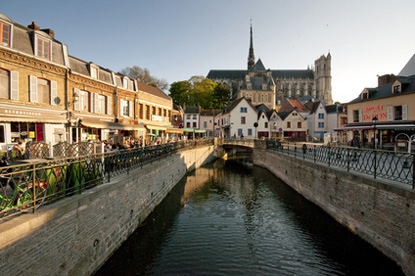
Amiens (pop. 135,000) is renowned for its magnificent Gothic cathedral, the Cathédrale Notre-Dame d'Amiens, which is one of the largest in France and a UNESCO World Heritage Site. The city has a long history dating back to pre-Roman times as Samarobriva, and it has been a significant cultural and economic center, particularly known for its textile industry. Amiens suffered significant damage during both World Wars but has been rebuilt with a blend of historical and modern architecture. Today, it is a bustling university town with vibrant neighborhoods like Saint-Leu and is often referred to as the "little Venice of the north" due to its picturesque floating gardens along the Somme River.
Interesting Facts about Amiens
- Amiens Cathedral, the largest Gothic cathedral in France, is a central landmark of the city and has been listed as a UNESCO World Heritage Site.
- The city was originally called Samarobriva, meaning "Somme bridge" in Gaulish, and was the central settlement of the Ambiani tribe.
- Amiens is known as the "little Venice of the north" due to its numerous canals and floating gardens called "hortillonnages".
- The famous science fiction author Jules Verne lived in Amiens for 34 years and served on the city council for 15 years.
- Amiens was the site of a crucial battle in 1918 that marked the beginning of the Hundred Days Offensive, leading to the end of World War I.
- The city is the birthplace of French President Emmanuel Macron.
- Amiens is renowned for its textile industry, particularly for its velours (velvet) production during the 18th and 19th centuries.
- The Maison de Jules Verne, where the author lived and wrote more than 30 novels, is now a museum open to the public.
- Amiens boasts one of the largest university hospitals in France, with a capacity of 1,200 beds.
- The city is famous for its local delicacy, macarons d'Amiens, almond-paste biscuits that were favourites of Catherine de Medici in the 16th century.
History
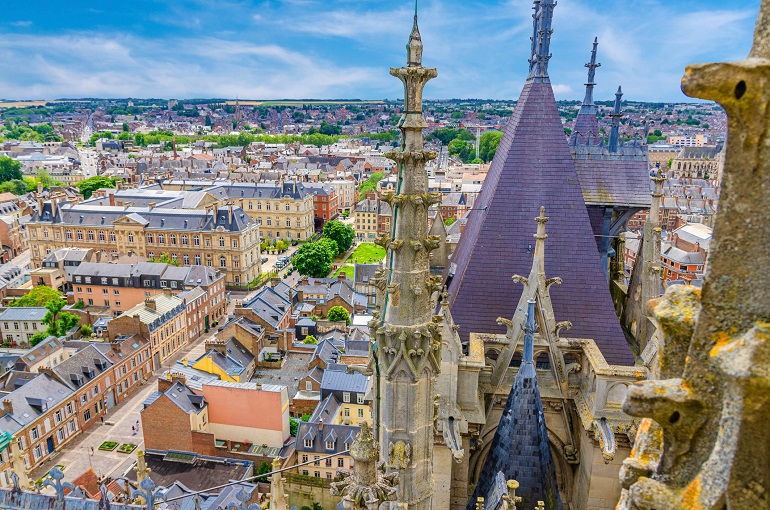
The region was settled by the Ambiani tribe before the Roman conquest of Gaul. Amiens was then known as "Samarobriva", which in Celtic language means "Bridge (briva) on the Somme (Samara)".
Samarobriva was already a major hub in Roman times, on the road between Lyon (Lugdunum) to Boulogne (Gesoriacum). This allowed the city to develop quickly. A vast forum occupied what is now the town hall and the court of justice. There were thermae and an amphitheatre for 15,000 people.
In 287, Saint Fermin becomes the first bishop of Amiens. He was beheaded in 303 for preaching Christianism. During Winter 338-339, a Roman soldier, Martinus, shares his coat with a poor man. The soldier would later become known as Saint Martin of Tours.
Due to the increasing frequency of Germanic invasions, the amphitheatre of Samarobriva is transformed into a fortress of 20 hectares (50 acres), the largest fortified place in Northern Gaul. This does not prevent the city from being taken successively by the Alans, the Vandals, and the Burgunds.
In the 5th century, the King of the Salian Franks based inTournai, Clodio (396-448), takes control of the region. His son, Merowig, after whom the Merovingian dynasty was named, is proclaimed king in Amiens. Merowig's grandson, Clovis I (466-511), would unify theFranks and conquer the last remnants of the Western Roman Empire, the Domain ofSoissons.
The Vikings plunder Amiens in 859 and again 882. They burnt down the first cathedral. In 1113, Amiens its first charter of municipal rights against the local lord. But Enguerrand de Boves, Count of Amiens, refuses to recognise the charter. King Louis VI then comes to support the bishop against the count. Amiens becomes part of the Royal domain in 1185. It is ceded to the Duke of Burgundy by the Treaty of Arras in 1435, but reacquired by the King Louis XI in 1477.
In 1597, the Spaniards capture the city using a Trojan horse technique. King Henry IV will have to besiege the city for six months before taking it back.
During the 18th and 19th centuries, Amiens is renowned for its velvet industry. On 25 March 1802, Napoleon Bonaparte obtains a treaty of peace between France and Britain, known as the Treaty of Amiens.
Amiens was badly damaged during both World Wars, during the Battle of Amiens in August 1918, and again by German bombing in 1940.
Main Attractions
Amiens Cathedral
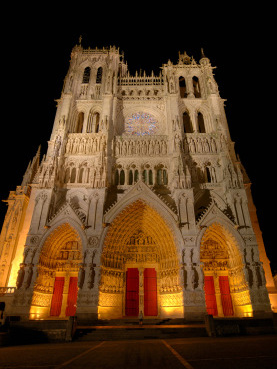
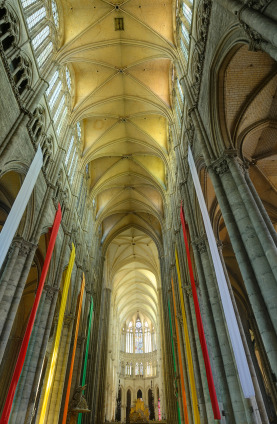
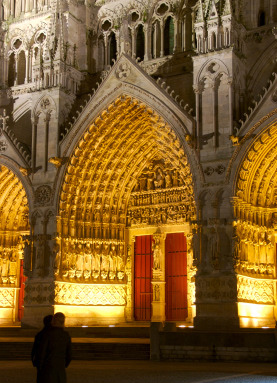
Amiens Cathedral, officially Notre-Dame d'Amiens, is the largest Gothic cathedral in France and a UNESCO World Heritage Site since 1981. Built remarkably quickly between 1220 and 1270, this magnificent structure was commissioned by Bishop Evrard de Fouilloy after the previous Romanesque cathedral was destroyed by fire.
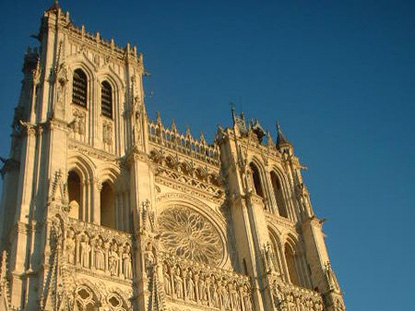
The cathedral boasts impressive dimensions with a length of 145 metres, a width of 70 metres, and soaring vaults reaching 42 metres in height. It is the tallest complete cathedral in France (112.7 m), and second largest in the world in volume (200,000 m³) after Yamoussoukro. It also has the tallest nave vaults in France (42.3 m). Its elaborate west façade features three deep-set arched portals, a gallery of kings, and a stunning rose window measuring 13 metres in diameter. Inside, visitors can admire the 234-metre labyrinth pavement, bronze recumbent figures, 110 carved wooden stalls, the Weeping Angel, and the Golden Virgin.
The cathedral is open to visitors throughout the year with free admission. From April to September, it welcomes visitors from 8:30 to 18:15, with extended hours on weekends, while from October to March, it opens from 8:30 to 17:15, again with extended weekend hours. Guided tours are available to access the towers, which offer splendid views of Amiens, and the treasury, which houses precious relics including the Paraclete votive crown and allegedly the head of Saint John the Baptist. A special treat awaits visitors from June to September and during December, when a spectacular light show illuminates the façade, recreating its original medieval polychromy in a dazzling display of colour.
Other attractions
The city's belfry symbolises the independence of the municipality. The lower part was built between 1406 and 1410, while the Baroque clock tower dates from 1749.
Facing the North Station, the Perret Tower was one of Europe's first skyscrapers when it was constructed (between 1948 and 1954). It has 29 floors and rises to 110 meters (only 2 meters shorter than the cathedral's tower).
Also of interest is the octagonal Municipal Circus, built in 1889 and inaugurated by Jules Verne, an elected town councillor of Amiens from 1888 to his death in 1905.
Top Museums
Musée de Picardie
The Musée de Picardie is often referred to as the "little provincial Louvre" of Amiens. It was the first purpose-built museum in France, designed specifically to house works of art. The museum takes visitors on a journey through time, showcasing collections from prehistory to the present day. These include archaeological finds, medieval art, sculptures, and paintings. The museum's collections highlight the artistic and historical wealth of the region, with a focus on Picard origins. The building itself is a 19th-century monument, recently restored and set amidst beautifully landscaped gardens.
Maison de Jules Verne
The Maison de Jules Verne is a must-visit for literature enthusiasts. This 19th-century townhouse offers a glimpse into the private life of the famous author of "Extraordinary Journeys." Visitors can explore the intimate settings where Verne lived and worked, gaining insight into his life and literary inspirations.
Hotel de Berny Museum
While less detailed information is available about the Hotel de Berny Museum, it is one of the notable cultural institutions in Amiens. Typically, such museums offer historical insights into the region's architecture and cultural heritage.
Local Cuisine
Amiens boasts a rich culinary heritage that tantalises the taste buds of locals and visitors alike. The city's most iconic dish is the ficelle picarde, a savoury crêpe filled with ham, mushrooms, and cream, then gratinated to perfection. For those with a sweet tooth, the macaron d'Amiens is a must-try delicacy, distinct from its Parisian counterpart with its soft, almond-honey biscuit texture. Meat lovers will relish the pâté de canard en croûte, a duck pâté encased in a golden crust. The hearty bisteu, a potato and bacon pie, offers a comforting taste of traditional Picardy fare. To round off a meal, indulge in tuiles au chocolat, thin chocolate slices studded with almonds, available in various flavours. Don't forget to sample the local craft beers and ciders, which perfectly complement the region's robust cuisine.
Getting There & Around
Amiens, located about 150 km north of Paris, is easily accessible and well-connected by various modes of transport. By train, Intercités and TER services link Amiens to Paris in just over an hour, with the Gare d'Amiens conveniently situated in the city centre. For high-speed TGV services, travellers can use the Gare TGV Haute-Picardie, a short shuttle ride away. By car, Amiens is at the crossroads of major motorways such as the A16 and A29, making it a straightforward drive from Paris or other regions. Beauvais-Tillé Airport, just an hour away by bus, offers convenient air travel options. Once in the city, getting around is seamless with Amétis buses covering urban and suburban areas, as well as a bike-sharing system called Vélam for eco-friendly exploration. Walking and cycling are also popular choices for navigating this compact and charming city.
| Travel destinations in Picardy | ||||||||||||||
|---|---|---|---|---|---|---|---|---|---|---|---|---|---|---|
|
|
|
|
| ||||||||||
|
|
|
|
| ||||||||||


