Geographic distribution
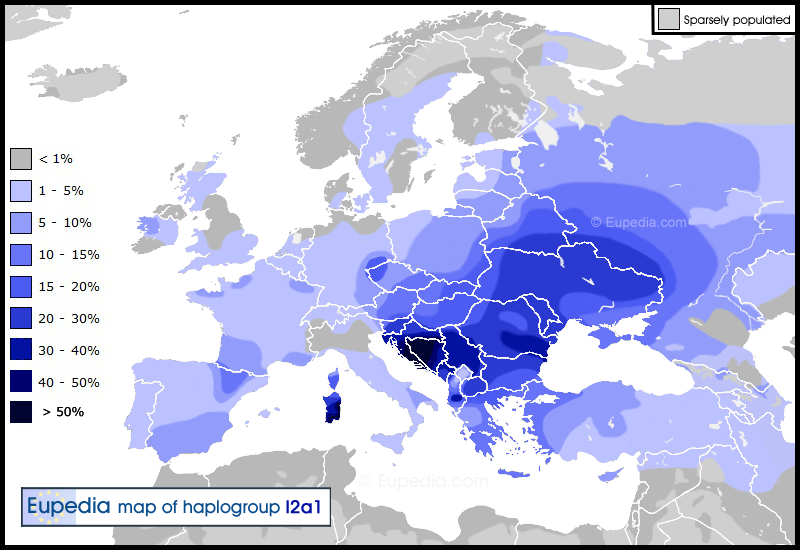
Haplogroup I2 is the most common paternal lineage in former Yugoslavia, Romania, Bulgaria and Sardinia, and a major lineage in most Slavic countries. Its maximum frequencies are observed in Bosnia (55%, including 71% in Bosnian Croats), Sardinia (39.5%), Croatia (38%), Serbia (33%), Montenegro (31%), Romania (28%), Moldova (24%), Macedonia (24%), Slovenia (22%), Bulgaria (22%), Belarus (18.5%), Hungary (18%), Slovakia (17.5%), Ukraine (13.5%), and Albania (13.5%). It is found at a frequency of 5 to 10% in Germanic countries.
Phylogeny of I2
If you are new to genetic genealogy, please check our Introduction to phylogenetics to understand how to read a phylogenetic tree.
The phylogenetic tree of I2 evolved a lot over the last 10 years and top-level subclades were renamed more often than for any other haplogroup except R1b. To avoid all confusion it is recommended to double-check the defining mutations (SNP's) when reading older studies or making references to a particular subclade. Several minor subclades were not included due to lack of space.

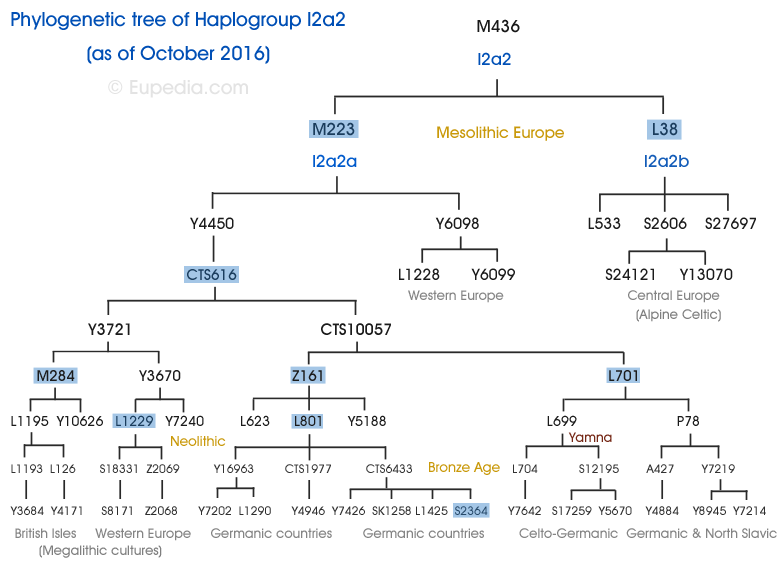 Click to enlarge

- I2* (M438/P215/S31)
- I2a (L460)
- I2a1 (P37.2)
- I2a1a (CTS595)
- I2a1a1 (M26)
- I2a1a1a (L672)
- I2a1a1a1 (L160)
- I2a1a1a1a (PF4088)
- I2a1a1a1a1 (CTS11338)
- I2a1a1a1a1a (Z105)
- I2a1a1a1a1b (PF4189)
- I2a1a1a1b (F1295)
- I2a1a2 (L880)
- I2a1a3 (L1286)
- I2a1b (M423)
- I2a1b1 (M359.2/P41.2)
- I2a1b2 (L161.1/S185)
- I2a1b3 (L621/S392)
- I2a1c (L1286)
- I2a1d (L880)
- I2a1e (L1294)
- I2a2 (S33/M436/P214)
- I2a2a (M223)
- I2a2a1 (M284)
- I2a2a1a (L1195)
- I2a2a1a1 (L126/S165, L369)
- I2a2a1a2 (L1193)
- I2a2a2 (L701)
- I2a2a2a (P78)
- I2a2a2b (L699/L703)
- I2a2a3 (Z161)
- I2a2a3a (L801/S390/Z76)
- I2a2a3a1 (P95)
- I2a2a3a2 (Z78)
- I2a2a3b (L623)
- I2a2a4 (L1229)
- I2a2a4a (Z2054)
- I2a2a4b (L1230)
- I2a2a5 (L1228)
- I2a2b (L38/S154)
- I2b (L416)
- I2c (L596)
Origins & History
Haplogroup I is the oldest major haplogroup in Europe and in all probability the only one that originated there (apart from very minor haplogroups like C1a2 and deep subclades of other haplogroups). Haplogroup IJ would have arrived from the Middle East to Europe some 35,000 years ago, then developed into haplogroup I soon afterwards. It has now been confirmed by ancient DNA test that the first Homo sapiens to colonize Europe during the Aurignacian period (45,000 to 28,000 years ago), belonged to haplogroups CT, C1a, C1b, F and I.
I2 (M438/P215/S31) is thought to have originated during the Late Paleolithic, around the time of the Last Glacial Maximum (LGM), which lasted approximately from 26,500 to 19,000 years ago. I2 probably appeared in western Europe, although its exact region of origin cannot be determined since Paleolithic Europeans were nomadic hunter-gatherers. The oldest I2 sample recovered from archeological skeletons is a 13,500 year-old man from the Grotte du Bichon in Switzerland associated with the Azilian culture (see Jones et al. (2015)). His maternal lineage was U5b1h. As of October 2016, 15 Mesolithic European Y-DNA samples have been tested. Among them one belonged to haplogroup C1a2 (in Spain), one to F (in Germany), two to I* (in France), and six to I2 (Luxembourg and Sweden), including to I2a1* (P37.2), I2a1a1a (L672), I2a1b (M423) and I2c2 (PF3827). The maternal (mtDNA) lineages that they carried were U2e, U4, U5a1, U5a2 and U5b. The four samples from Russia belonged to Y-haplogroup J*, R1a1 (2x) and R1b1a. This shows that there was already a certain amount of diversity among Mesolithic European lineages, although many of these lineages (C1a2, F, I*, J*) are now exceedingly rare. Haplogroup I2a1 seems to have come out of the Neolithic period as the big winner for reasons that are not yet clear.
The analysis of Early Neolithic genomes from Anatolia by Mathieson et al. (2015) shows that I2c (L596) was already present in north-western Turkey 8,500 years ago, and had been assimilated by the Neolithic farmers on their way from the Fertile Crescent to Europe. Various ancient DNA studies conducted between 2014 and 2016 revealed that all Mesolithic European lineages became absorbed by the wave of Neolithic farmers. Yet I2a stood out as the most common among them, amounting to 16% of the 69 Neolithic Y-DNA samples tested. That places it as the second most common paternal lineage after G2a, the original lineage lineage of Anatolian farmers. I2a1 seems to have particularly prospered in the Starčevo–Kőrös–Criş culture (6000-4500 BCE) in Southeast Europe, where it is still one of the main male lineages today. I2a1 also appeared in the Printed-Cardium Pottery culture (5000-1500 BCE) in the western Mediterranean. The modern Sardinians and Basques inherited the biggest share of their genome from those Neolithic farmers from the Printed-Cardium Pottery culture.
Although only one I2a2 has been found during the early or middle Neolithic samples so far (a I2a2a-M223 from Spain), many of them showed up during the Copper and Bronze Ages. Copper and Bronze Age samples consist of one I2a2, two I2a2a and one I2a2a1 (CTS616) in Spain, one I2a2a1b1b2 (S12195) in southern Russia (Yamna culture), one I2a2a1 (CTS9183) and one I2a2a1a2a (L229) in Hungary (Vatya culture), six I2a2b (L38) in Germany (Unetice and Urnfield cultures). I2a1 samples from the Copper Age include an I2a1a1 from northern Italy (Remedello culture), an I2a1 from Hungary (Vatya culture). I2c2 was also found in the Unetice culture in Germany.
Haplogroup I2a1 (P37.2)
Haplogroup I2a1 is by far the largest branch of I2 and the one most strongly linked to Neolithic cultures in south-east, south-west and north-west Europe.
Distribution of haplogroup I2a1 (formerly I2a) in Europe
Haplogroup I2a1a1 (M26)
I2a1a (M26, L158, L159.1/S169.1) was known as I1b2 until 2005, I1b1b in 2006-7, and I2a1 from 2008 to 2010. It is found in all Western Europe, and reaches maximum frequencies among the Sardinians (37.5%) and the Basques (5%), two population isolates. M26 is geographically restricted to the British Isles, the Low Countries, France, western Germany, Switzerland, Sardinia, Sicily, the west coast of Italy, Iberia and the Mediterranean coast of the Maghreb. The only M26 negative for the L160 mutation are confined to Ireland.
I2a1a-M26 was probably one of the main paternal lineages of the Megalithic cultures of western Europe during the Neolithic and Chalcolithic periods. I2a1a1a (L672) was already found in Mesolithic Sweden, which implies that I2a1a had a very wide distribution from Iberia to Scandinavia during the Mesolithic period. Later, they would have adopted agriculture by intermixing with Near Eastern newcomers.
Haplogroup I2a1b (M423)
I2a1b (M423, L178) was known as I1b until 2007, and I2a2 from 2008 to 2010. The main subclade, representing over 90% of all M423 lineages is L621 and its subclade L147.2. The other subclades are L41.2 (very rare) and L161.1 (found mostly in Germany and the British Isles).
Haplogroup I2a1b-L621
This branch is found overwhelmingly in Slavic countries. Its maximum frequencies are observed among the Dinaric Slavs (Slovenes, Croats, Bosniaks, Serbs, Montenegrins and Macedonians) as well as in Bulgaria, Romania, Moldavia, western Ukraine and Belarus. It is also common to a lower extent in Albania, Greece, Hungary, Slovakia, Poland, and south-western Russia. I2-L621 (L147.2+) is also known as as I2a-Din (for Dinaric).
The high concentration of I2a1b-L621 in north-east Romania, Moldova and central Ukraine reminds of the maximum spread of the Cucuten > Trypillian culture (4800-3000 BCE). No Y-DNA sample from this culture has been tested to date, but as it evolved as an offshoot from the Starčevo–Kőrös–Criş culture, it is likely that I2a was one of its main paternal lineages, and a founder effect could have increased considerably its frequency. The Cucuten > Trypillian culture was the most advanced Neolithic culture in Europe before the Indo-European invasions in the Bronze Age and seems to have had intensive contacts with the Steppe culture before the expansion of Yamna to the Balkans and Central Europe (see histories of R1a and R1b). From 3500 BCE, at the onset of the Yamna period in the Pontic-Caspian Steppe, the Cucuten > Trypillian people started expanding east into the steppe of what is now western Ukraine, leaving their towns (the largest in the world at the time), and adopting an increasingly nomadic lifestyle like their Yamna neighbours. It can easily be imagined that Cucuten > Trypillian people became assimilated by the Yamna neighbours and that they spread as a minority lineage alongside haplogroups R1a and R1b as they advanced toward the Baltic with the Corded Ware expansion. Alternatively, I2-L621 lineages could have lived in relative isolation from the mainstream Proto-Indo-European society somewhere around Ukraine, Poland or Belarus, then as the centuries and millennia passed, would have blended with the predominantly R1a populations around them. The resulting amalgam would have become the ancestors of the Proto-Slavs.
Nowadays, I2a1 is five to ten times more common than G2a in Southeast Europe, while during the Neolithic period G2a was approximately four times more common. What can explain this complete reversal? At one point in history, I2a1 lineages seem to have benefited from being on the winning side. Apart from a minor boost from (hypothetically) joining Yamna's westward expansion to Europe, the principal determining event that allowed I2a1b-L621 to become a major Eastern European lineage was probably the Slavic migrations from the 6th to the 9th century CE. Most modern Eastern Europeans belonging to I2a1b fit into the L147.2 (aka CTS10228, CTS2180 or Y3111) subclade, which is thought to have arisen 5,600 years ago (just before the Yamna period and the Trypillian expansion into the steppe), but has a TMRCA of only 2,300 years according to Yfull. The minority of I2a1b-L621 individuals negative for L147.2 are all found around eastern Poland, Belarus and western Ukraine, suggesting that this is where this lineage survived since the Chalcolithic. The I2a1b-L147.2 subclade seems to have expanded very fast from 1900 years ago, which is concordant with the timing of the Slavic ethnogenesis, considering that it takes a few centuries before one man can have enough male descendants to start having an impact at the scale of a population. This I2-L147.2 ancestor would have such an impact on the burgeoning Early Slavic population, still small 2,300 years ago, but booming.
After the Germanic tribes living in eastern Germany and Poland, like the Goths, the Vandals and the Burgundians, invaded the Roman Empire, the Slavs living further east filled the vacuum. Following the collapse of the Western Roman Empire in 476, the Slavs moved in the Dinaric Alps and the Balkans. By the 9th century, the Slavs occupied all modern Slavic-speaking territories, apart from the eastern Balkans under the control of the Turkic-speaking Bulgars.
Nowadays northern Slavic countries have between 9% (Poland, Czech republic) and 21% (Ukraine) of I2a-L621, while southern Slavs have between 20% (Bulgaria) and 50% (Bosnia). The higher percentage of I2a-Din in the south is probably just due to another founder effect due to the fact that the South Slavs originated in western Ukraine, where the ratio of I2a to R1a was higher. Virtually all Dinaric I2a falls under the L147.2 branch, and the majority to the S17250 ramification, who descend from a common patrilinear ancestor who lived only 1,800 years ago.
Haplogroup I2a1b-L161.1
Commonly known in genetic genealogy circles as I2-M423-Isles, L161.1 is found at highest frequencies in western Ireland (5-10%) and the Scottish Highlands (1-5%), but is also found at low frequencies (> 1%) throughout Central and Western Europe, from Latvia, Lithuania and Belarus to the British Isles, and from Scandinavia to north-western Spain. It has also been found in Albania, northern Greece, Bulgaria and Romania.
The oldest known I2a1b-L161.1 individuals are the 8,000 year-old Loschbour man from Mesolithic Luxembourg, and a 7,800 year-old man from Motala in southern Sweden. I2a1b-L161.1 was probably scattered over most of Europe during the late Glacial and immediate postglacial periods, and in all likelihood integrated Neolithic society like all other Mesolithic lineages. I2a1b-L161.1 was very possibly one of the main Neolithic lineages in the British Isles during the Megalithic period, and would therefore have been among the men who built Stonehenge, Knowth, Newgrange and other great Megalithic sites. Its low frequency today and its confinement to the north-western and south-eastern fringes of Europe is indubitably the result of the numerous waves of Indo-European migrations over the last 5,000 years. The Proto-Celtic haplogroup R1b-L21 is now known to have arrived in Ireland around 2000 BCE (see Cassidy et al. 2015), only a few centuries after R1b first arrived in Central Europe. The transition was rapid, with R1b tribes overwhelming the Neolithic population of the British Isles in only a few centuries and pushing them further west and north, where L161.1 survives today.
Haplogroups I2-L880, I2-L1286 and I2-L1294
These minor subclades are found at low frequencies mainly in north-Western Europe. Like I2a2 (see below) these lineages are probably the descendants of central and north-west European hunter-gatherers.
L880 is a very rare subclade identified in Germany, Luxembourg and France.
L1286 originated during the Late Paleolithic period. Nevertheless, 99% of modern carriers belong to the L233 subclade and share a common patrilinear ancestor less than 2,000 years ago. L233 is most common in the British Isles, but is occasionally encountered in the Netherlands, Scandinavia, Germany, France and Poland.
L1294 is also very rare and has only been found in Germany, France and Britain.
Haplogroup I2a2 (P214)
I2a2 (S33/M436/P214, P216/S30, P217/S23, P218/S32, L35/S150, L37/S153, L181) was known as I1c until 2005 and I2b until 2010. It is associated with the pre-Celto-Germanic people of north-Western Europe, such as the megaliths builders (5000-1200 BCE). Its age has been estimated between 21,000 and 13,000 years old, which corresponds to the Epipaleolithic period.
I2a2 is found in most of Europe and seems to have had a continent-wide distribution before the arrival of Neolithic farmers. Several Mesolithic I2a2 samples have been identified to date, mostly by Mathieson et al. (2017). This includes individuals from southern Germany (M223 from c. 7200 BCE), the Iron Gates between Serbia and Romania (Z161 from c. 6200 BCE), Latvia (CTS10057 from c. 5500 BCE) and southeast Ukraine (L699 from c. 5400 BCE and L701 from c. 5200 BCE).
Remains from the Late Neolithic Sredny Stog culture (4500-3500 BCE) in Ukraine and of the Chalcolithic Globular Amphora culture (3400-2800 BCE) from Ukraine and Poland, were also tested by Mathieson et al. (2017). All six individuals from the Globular Amphora belonged to haplogroup I2a2. The deeper clade was identified for only two of them, and both belonged to the CTS10057 branch, including one positive for the Z161 mutation. The Sredny Stog people carried a mix of I2a2, R1, R1a and R1b lineages. The two I2a2a individuals belonged to the CTS10057 and L701 subclades. L701 was also found in Copper Age Bulgaria. Other I2a2a individuals was also found in Neolithic Scotland (L1195 and CTS10057), Neolithic Spain (CTS616 and Z161) and Neolithic Hungary (CTS10057).
During the Early Bronze Age, I2a2a was found in southern Russia during the Yamna culture (L699), in Hungary (L1229), and in Germany (L38). This very ancient dispersal and its relatively low modern frequency makes it very difficult to assess what happened to each branch before the Late Bronze Age or the Iron Age.
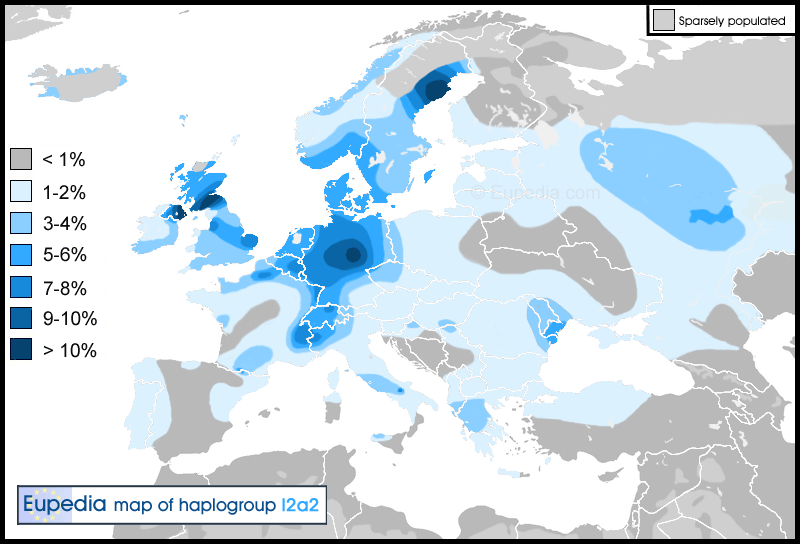
Nowadays, I2a2 peaks in central and northern Germany (10-20%), the Benelux (10-15%) as well as in northern Sweden. It is also found in 3 to 10% of the inhabitants of Denmark, eastern England, and northern France. It is rarer in Norway, except in the south, where the Danish influence was the strongest historically.
Distribution of haplogroup I2a2 (formerly I2b) in Europe
There are two major subclades of I2a2 : I2a2a and I2a2b, the former further subdivided in four subclades:
Haplogroup I2a2a (M223)
I2a2a (formerly I2b1) amounts to over 90% of I2a2.
I2a2a1 (M284+)
I2-M284 occurs almost exclusively in Britain and Ireland, but has also been found in Portugal, France, Germany and Norway. It is a very old haplogroup, originating some 10,000 years ago and is split in two subclades Y10626 and L1195, which are each about 7,000 years old. Present-day carriers share a common ancestor who lived approximately 5,500 to 6,000 years ago, during the Megalithic age.
I2a2a2 (L701+)
I2-L701 was formed a bit over 10,000 years ago and quickly split in two main branches: L699 and P78.
The L699 branch was found in the Yamna culture (S12195 subclade), the homeland of Proto-Indo-European speakers and of haplogroup R1b-L51. A rare subclade, it is found mostly in Hungary, Germany, Switzerland, the Benelux, France and Britain, all countries with relatively high percentages of haplogroup R1b. L699+ matches the I2 Continental 3b clade at Family Tree DNA.
The P78 branch split into two clades A427 and Y7219 some 5,300 years ago, at the time of the Yamna culture in the Pontic Steppe. It is distributed mostly across Central and Northwest Europe, particularly in Poland, Germany and the Netherlands, but also in Romania, Hungary, Scandinavia, Britain, Ireland, France and Italy. Isolated samples have also been found in Greece, Turkey and Armenia. Like the L701 clade, it might well have originated in the Yamna culture and spread with Proto-Indo-European speakers to Central Europe. One branch of A427 is found among Ashkenazi Jews with mostly German surnames, probably through the convertion of Germans to Judaism during the Middle Ages. P78+ matches the I2 Continental 3a clade at Family Tree DNA.
I2a2a3 (Z161+)
I2-Z161 is the largest I2a2 subclade today. Also formed about 10,000 years ago, it is composed of three top-level subclades: L623, Y5188 and L801. The two first are extremely rare and have only been identified in Scotland and Ireland. 99% of Z161 members belong to L801 and share a common ancestor who lived 4,000 years ago, although L801 subclades experienced a dramatic expansion in the last 2,000 years. L801 is found predominantly in Germanic countries, with a particularly high concentration in Denmark, Germany, the Netherlands, England and in Northwest Sicily (Norman settlement). It is also found at lower densities throughout the rest of Europe, from Portugal to Russia. I2-L801 is thought to have been propagated around Europe by the Danish Vikings (Britain, Normandy, Sicily), the Swedish Vikings (Baltic, Russia, Ukraine), the Goths (Moldova, Balkans, Italy, south-west France, Spain), the Suebi (Portugal and Galicia), the Lombards (attested by a hotspot in Campobasso, Molise), and the Franks (Rhineland, Belgium). All top level subclades are found in Germany, which points to its place of origin. Z161+ commonly known as the I2 Continental clade (except Continental 3).
- The Y16963 and CTS1977 subclades are also found in Germany, the Benelux and the British Isles.
- L1425 is found in Scandinavia, Germany, the Low Countries, England, France, Switzerland and Italy.
- S2364 is the largest and most diversified I2a2 subclade. It has the widest distribution of any subclade. It is found in all Germanic countries, including Britain, but also Ireland, the Czech Republic, Hungary, Poland, Latvia, Russia, Ukraine, Bulgaria, Italy, France, Spain and Portugal. This suggests that it could have been propagated by the Franks, Anglo-Saxons, Goths and Vikings, among others. S2364 originated nearly 4,000 years ago, but its numerous subclades developed between 3,000 and 1,000 years ago, which matches the time frame of the Germanic ethnogenesis and Germanic migrations.
- L1198 is a large branch found mostly in western Europe. That lineage emerged about 3,000 years ago and expanded quickly during the Germanic Iron Age from circa 500 BCE. It is divided in three branches that seem to have their roots in Sweden or Germany.
- S20905 is found in Germany (Rhineland), France (Alsace), Switzerland, Hungary, as well as England, Sweden and Finland. The continental group (Z190+) might descend from the Alemanni, Suebi or another Germanic tribe that settled around Swabia.
- Y6060 is found in the Netherlands and the British Isles and could be of Frisian and Anglo-Saxon origin.
- Y17535 is found in Bohemia, Alsace, Galicia (Spain), Portugal and Britain. The continental branch could be linked to the Suebi tribe, which migrated from Swabia (SW Germany and Alsace) to Galicia and northern Portugal.
Amorim et al. (2018) tested the ancient Lombard-era DNA from 6th-century Italy and Hungary and identified one I2a2a-L801 and three I2a2a-ZS20 (downstream of L801 and S2364) samples in Szólád in western Hungary. They were all autosomally fully northwest European like the I1-L22, R1a-Z284 and the R1b-U106 samples, but unlike the other samples (E-V13, E-V22, G2a1a, I2a2a-L1229, R1b-U152, R1b-Z2103, T1a1a) that were clearly more southern European.
I2a2a4 (L1229+)
I2-L1229 originated some 9,000 years ago. It divided in two branches S18331 and Z2069 about 5,000 years ago. S18331 is the least common of the two and is scattered all over western Europe.It dates from the Late Neolithic/Chalcolithic period and could have been associated with Atlantic Megalithic cultures. Z2069 is more common but has a narrower distribution, limited mostly to central and northern Germany, England, Normandy and other parts of France. It is also found among English surnames in Ireland, although not Norman ones (but rather Anglo-Saxon ones). Its much higher density in Germany and England than in Denmark or France, and its absence from Sicily, indicate that it is probably an Anglo-Saxon lineage rather than Norman/Viking.
Haplogroup I2a2b (L38/S154)
I2a2b (formerly I2b2) could have appeared soon after the Last Glacial Maximum, perhaps 17,000 years ago. Most of its branches would have become extinct and only one survived with a patriarch living during the Bronze Age, probably in Germany. The oldest known L38 sample comes from the Unetice culture in central-east Germany 4,000 years ago. Four out of the six samples from the 3,000 year old Lichtenstein Cave in central Germany belonged to L38+ as well. The cave was part of the Bronze Age Urnfield Culture.
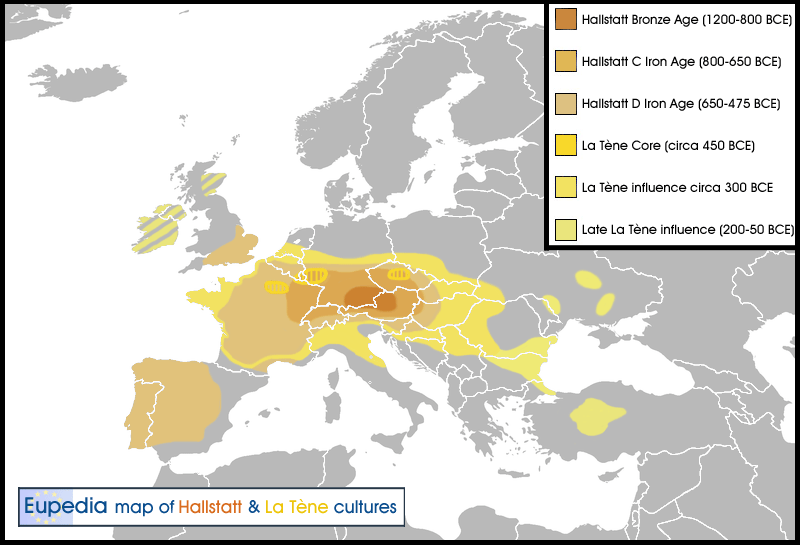
Based on the STR dating, it is believed that this lineage spread from Germany to England via Belgium in the Late Iron Age with the Celtic people of the Hallstatt and La Tène cultures. I2a2b is therefore essentially a Alpine Celtic haplogroup. Nowadays I2a2b has a distribution mostly limited to Alpine Italy (esp. Piedmont), Switzerland, the German Rhineland, the Harz mountains, the Low Countries, eastern France, and the British Isles (with the exception of Cornwall and Wales). Isolated samples have been found in western Spain, Hungary, Romania, Bulgaria, central Turkey and Ukraine, all places settled by Alpine Celts.
The distribution of I2-L38 matches fairly well that of haplogroup R1b-U152 north of the Alps. Both haplogroups are also found at low frequency in Hungary, Romania, Bulgaria and central Turkey, probably reflecting the migration of La Tène Celts in the third century BCE (see map). R1b-U152 is associated with both the Central European Celts (Unetice, Urnfield, Hallstatt, La Tène) and the Italic people. In Italy, I2-L38 is limited to the Alpine region, mostly the north-west, where Gaulish tribes settled, and it is likely that I2-L38 was brought to Italy by Celtic migrations many centuries after the arrival of Italic tribes from the Alpine Danube region. I2-L38 people would therefore have been autochthonous to the region between the Alps, Central Germany and the Low Countries and were assimilated into the Celtic society during the Hallstatt or La Tène period.
Haplogroup I2b
I2b (L416, L417, L418) is a very minor subclade so far observed in a few samples from Italy, Croatia, Germany, Scotland and Iran.
Haplogroup I2c
I2c (L596, L597) could have formed some 21,000 years ago, although most I2c people alive today share a common patrilinear ancestor in the last 10,000 years. I2c could have originatedin Central Europe during the Mesolithic period. It can be divided in four groups: A, AB, B and C.
- Group A is geographically limited to Switzerland, Germany, the Netherlands, Sweden, Poland, Britain and Ireland.
- Group AB has been found in north-west Iran, around the Caucasus (Armenia and Georgia), in Turkey and in France.
- Group B is found at low frequencies in West Asia (Turkey, Georgia, North Ossetia, Armenia, Azerbaijian and north-west Iran), in Southeast Europe (Moldova, Romania, Bulgaria, Albania, Crete), in Balto-Slavic countries (Russia, Ukraine, Belarus, Lithuania, Poland, Slovakia, Czech Republic), as well as in Germany, Austria, Italy, Spain and Britain.
- Group C has a similar distribution to group A but has also been found in France, Italy and Norway.
Groups A and C seem to have expanded respectively during the Celtic Bronze and Iron ages, alongside R1b-S116/P312.
Additionally, the subclade I2c1 (L1251) has recently been identified. It is found mostly in Germany and England and in their periphery (Ireland, Norway, France, Italy, Poland). This subclade is thought to be approximately 6000 years old, which places it in the Late Neolithic period. It may be associated with hunter-gatherers from Germany who adopted agriculture after coming into contact with Near-Eastern farmers from the Linear Pottery culture.
Famous individuals
I2a1b-L621 branch (Slavic)

The famous Protestant reformer Martin Luther appears to have belonged to haplogroup I2a-Din-N (L147.2, aka CTS5966 or CTS10228) according to probable relatives whose haplotypes can be found on the Luther Surname DNA Project, including one genealogically traceable 1st cousin 13 times removed, as well as other relatives on ySearch (especially ySearch ID: YTE6E).

Miklós Horthy (1868-1957), was Regent of of the Kingdom of Hungary from 1920 to 1944. Prior to this, Admiral Horthy served as commander-in-chief of the Austro-Hungarian Navy in the last year of the First World War. In 1919, he ousted the communists of Béla Kun from Hungary and banned the Hungarian Communist Party. The following year was declared Regent and Head of State. Cousins of Horthy posted their Y-DNA results at MolGen, and all belonged to I2a-Din-N (or I2a1b3a in current ISOGG nomenclature).

According to the results of a cousin posted on Poreklo, the Serbian tennis player Novak Djokovic (b. 1987) belongs to I2-PH908 (downstream of L147.2 and S17250). Djokovic is considered one of the greatest tennis players of all time. As of April 2017, he has won 12 Grand Slam singles titles, the fourth most in history, and held the No. 1 spot in the ATP rankings for a total of 223 weeks.
Other famous members of haplogroup I2a1b-L621
- Ðorðe Petrovic, better known by the sobriquet Black George, or Karaðorðe (subclade I2a1b-CTS10228): was a Serbian revolutionary leader who fought for his country's independence from the Ottoman Empire during the First Serbian Uprising of 1804–1813. A descendant of his paternal uncle was tested.
- Živojin Mišić (subclade I2a1b-CTS10228): A Serbian vojvoda noted for his military successes in World War I and other wars. Sinisa Jerkovic at Poreklo provides the haplotype of his cousins, as well as an argument in favor of his relationship to the Božović family and his descent from a 15th century Serbian warrior named Captain Gojko.
I2a1a-L161.1 branch (British Isles)

Clan chiefs of Highland Scottish Clan Munro (Munros of Foulis) belong to haplogroup I2a1a-L161.1 > S2639 > A812 > Y12072 > Y12070 > PF4135 > Y11772 > Y12075 > Y12073, based on the testing of numerous clan members at Munro DNA Project.The American statesman James Monroe (1758-1831), one of the Founding Fathers of the United States and the 5th President of the United States from 1817 to 1825, was a descendant of the clan.
Other famous members of haplogroup I2a1a-L161.1
- Oliver Winchester (subclade I2a1a-L161): an arms manufacturer and the namesake of the Winchester rifle. The Winchester DNA Project has his family branch's haplogroup as I2a-Isles-B L161+.
- Jack Nance (subclade I2a1a-L161): An American actor famous for his role in Eraserhead and other films. Relatives of his have tested at the Nance DNA Project.
I2a1a-L233 branch
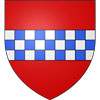
The Lowland Scottish Clan Lindsay descends from Sir Walter de Lindissie, who accompanied David of Scotland, Earl of Huntingdon, to claim his throne. According to Linday International, descendants from this lineage belong to haplogroup I2a1a-S21825 > Y4213 > Y4192 > L1287 > L233 > A8462 > FT11343 (aka Y36039), with a most recent common ancestor going back about 1000 years ago. The Lindsays have possessed the title of Earl of Crawford since 1398 (one of the most ancient extant titles in Great Britain), then also of Earl of Lindsay since 1633 and Earl of Balcarres since 1651.
Other famous members of haplogroup I2a1a-L233
- Matt Mead (subclade I2a1a-L233): is an American politician who has served as the 32nd Governor of Wyoming since 2011. Relatives tested and matched at the Mead Surname DNA Project.
I2a1a-M26 branch
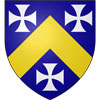
Several branches of the Lowland Scottish Clan Barclay were tested at the Clan Barclay International DNA Project. Most branches (Towie, Collairnie, Fife, Kilbirnie, Perceton) were found to belong to haplogroup I2a1a-M26 > L160 > PF4088 > PF4189 > Y84594 > BY68371. In the 17th century, the Barclay de Tolly, a branch of the Barclay of Towie from Banffshire, migrated to Mecklenburg, and later to what is now Latvia and Lithuania. Michael Andreas Barclay de Tolly (1761-1818) was a Baltic German field marshal and Minister of War of the Russian Empire during Napoleon's invasion in 1812 and the War of the Sixth Coalition. He was elevated to the rank of prince in 1815, a title that his descendants would keep until the 20th century.
I2a2a-L1195 branch (British Isles)

The American magazine publisher Henry Luce (1898-1967) belonged to haplogroup I2-M223-Isles-E L1193+, (a.k.a. I2a2a1 in current ISOGG nomenclature) according to the Luce Surname Project. He launched the magazines Time, Life, Fortune, and Sports Illustrated and was called "the most influential private citizen in the America of his day".

Bill Gates (b. 1955), the co-founder of the Microsoft Corporation and the richest man in the world according to Forbes for most of the time since 2000, appears to belong to haplogroup I2-Y3684 (aka Y3713) according to the testing of a close relative. Several other descendants of his patrilineal ancetsor Eutaces Gates (1580-1626) from Suffolk, England, also tested positive for that haplogroup in the Gates Surname Project.

American actor, producer, screenwriter, and comedian Vince Vaughn (b. 1970), seems to belong to haplogroup I2-M284 > L1195 > Y3709 > FT63416 according to the Vaughn Surname Project. He is a descendant of Elijah Vaughn (1776-1855).
I2a2a-L1229 branch (British Isles)

The Irish politician Enda Kenny (born 1951), who has been leader of Fine Gael since 2002 and Taoiseach since March 2011, had his DNA tested by National Geographic. Geneticist Spencer Wells further clarified that his subclade is I2-M223 CTS616+ at the Genetic Genealogy Ireland 2014 Conference. The Kinney & Variations Y-DNA Project showed that the I2a2a Kenny fall under the branch Y4450 > L1229 > Y4332.
Other famous members of haplogroup I2a2a-L1229
- Eddie Izzard (subclade I2a2a-L1229): an English stand-up comedian, actor and writer, who starred in the television series The Riches. A BBC documentary series he starred in, Meet the Izzards, stated that he tested as I2, and has matches named Frerichs and Speer.
I2a2a-Z161 branch (Germanic)

Davy Crockett (1786-1836), a 19th-century American folk hero, frontiersman and congressman from Tennessee, was found to belong to haplogroup I2-L801 > Z170 > CTS6433 based on the results from the Crockett Families Project.

John Tyler (1790-1862), the 10th President and 10th Vice President of the United States was identified as a member of haplogroup I2-L801 > Z170 > CTS1977 > Y4946 > Y5282 > CTS1858 > CTS10148 based on the results from the TYLER Family DNA Project (descendent of Henry Tyler).

Ralph Waldo Emerson (1803-1882), an American essayist, lecturer, philosopher, and poet who led the transcendentalist movement of the mid-19th century, probably belonged to haplogroup I2a2a-L801 > S2364 > Z78 > L1198 > Z190 > BY27818 based on the results of distant relatives from the Emerson/Amerson DNA Project. He is a descendant of Robert Emerson (1561-1620) and George Emerson (1484-c.1570), who are also the ancestors of Thomas Emmerson (1708-1790) in the project.

Andrew Johnson (1808-1875), the 17th President and 16th Vice President of the United States was identified as a member of haplogroup I2a2a-L801 > Z170 > Y16963 > L1290 > Y6647 > Y6644 > Y6639 > Y8830 > Y8831 based on the results from the > M223 Project.

George Armstrong Custer (1839-1876) was a United States Army officer and cavalry commander in the American Civil War and the American Indian Wars. He famously perished at the Battle of the Little Bighorn after leading the 7th Cavalry Regiment of the U.S. Army against the combined forces of the Lakota, Northern Cheyenne, and Arapaho tribes. Custer was descended from
Paulus Van Haren Küster (1644-1708) from Düsseldorf, Germany. Numerous descendants tested at the Custer DNA Project and were found to belong to haplogroup I2-L801 > Z161 > L623.

The American martial artist, actor, film producer and screenwriter Chuck Norris (b. 1940) belongs to haplogroup I2-L801 > Z170 > CTS6433 > S2364 > S2361 > Z78 > CTS8584 > Z185 > Z180 > L1198 > S20905 > Z190 > Y4869 > CTS12706 according to WikiTree. This lineage also includes his brother, the producer and director Aaron Norris, and his sons, the actor Mike Norris and the race car driver Eric Norris.

Stephen King (b. 1947), the renowned American author of contemporary horror, supernatural fiction, suspense, science fiction, and fantasy, belongs to haplogroup I2-L801 > Z170 > CTS6433 > S2364 > S2361 > Z78 > CTS8584 > Z185 > Z180 > L1198 > FT73935 > Y6060 > Y5748 > Y46018 > Y7272 according to genealogical research. King has received Bram Stoker Awards, World Fantasy Awards, and British Fantasy Society Awards, among others. In 2003, the National Book Foundation awarded him the Medal for Distinguished Contribution to American Letters.
I2a2a-P78 branch (Slavo-Germanic)

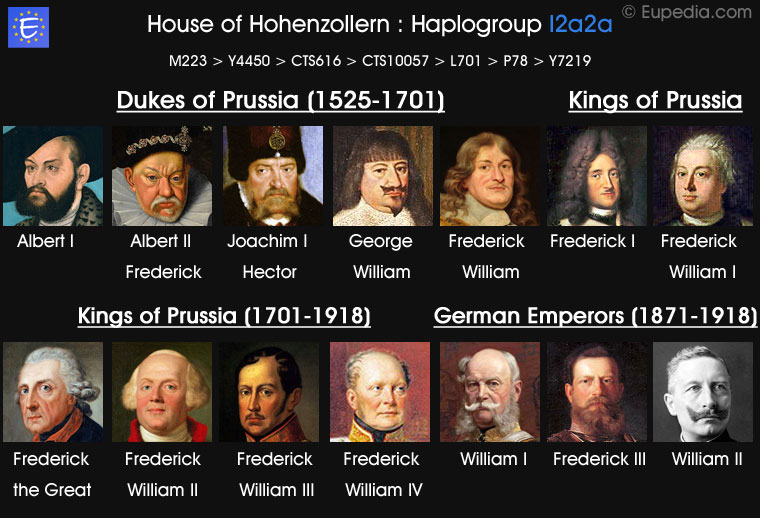
According to the Y-DNA testing of two illegitimate descendants of Prince Albert of Prussia (1809–1872), Geoffrey Rockel and Franz Rockel, the House of Hohenzollern would belong to haplogroup I2-P78 > Y7219. The Hohenzollern originated from Swabia in the 11th century, became Counts of Hohenzollern in 1204, then Margraves of Brandenburg in 1411, Dukes of Prussia from 1525, Kings of Prussia from 1701, and eventually German Emperors from 1871 to 1918 under Wilhelm I and Wilhelm II. The branch of Hohenzollern-Sigmaringen also ruled as Kings of Romania from 1881 to 1947.
I2a2b-L38 branch (Celtic)

American actor and producer Ted Danson (b. 1947) was shown to belong to haplogroup I2-L38 on the PBS TV series Finding Your Roots. Danson has been nominated for 17 Primetime Emmy Awards, winning two; ten Golden Globe Awards nominations, winning three; one Screen Actors Guild Award; and one American Comedy Award and has been awarded a star on Hollywood's Walk of Fame.
Other famous members of haplogroup I2a2b-L38
- Myles Standish (subclade I2a2b-L38): A Mayflower passenger, signer of the Mayflower Compact, and military leader for the Plymouth Colony. The Mayflower DNA Project has tested descendants of his.
- Nicholas Biddle (subclade I2a2b-L38): The President of the Second Bank of the United States. Coming from the prominent Biddle family, some of his relatives also likely to have carried I2 include millionaire Anthony Joseph Drexel Biddle, General John Biddle, and cinematographer John Biddle. His family has tested at BiddleEtc.
- Huey Long (subclade I2a2b-L38): A Louisiana politician famous for his left-wing populism and his motto, "Every Man a King," who was assassinated in 1935. His family has tested at the Long Surname DNA Project.
I2c1 branch

The American rock legend and cultural icon Elvis Presley (1935-1977) was revealed to belong to haplogroup I in the book Old World Roots of the Cherokee (p.42). Elvis's paternal grandfather was born out of wedlock and got his mother's surname. His Y-DNA test showed numerous exact matches with the Wallace surname in Scotland, who within haplogroup I belong overwhelmingly to the rare haplogroup I2c1a2a1a1a (F2044).
I2c2 branch

The I2b-L415 & I2c-L596 Haplogroup Project was able to determine that the haplotype of the Georgian house of Tsitsishvili was I2c2b2. The most famous member Pavel Tsitsianov (1754-1806), an Imperial Russian military commander and infantry general who also served as head of the Russian troops in Georgia and Viceroy of the Caucasus.
Other famous members of haplogroup I2c2
- Noe Zhordania (subclade I2c2-PF3827): The Prime Minister of the Democratic Republic of Georgia through most of its existence, as well as the head of the DRG's government in exile from 1921 to 1953. A descendant tested as I2c. This sample is available at ySearch ID: DUPCV.
- Taymuraz Mamsurov (subclade I2c2-PF3827): was President of the Republic of North Ossetia-Alania.from 2005 to 2015. The Ossetian DNA Project has the Mamsurov haplotype as I2c L596+ PF3827+.
Other famous members of haplogroup I2
- Ethan Allen (subclade I2a2a-Y6099): A Vermont militia general, politician, and writer famous for helping to found the state of Vermont, and for capturing Fort Ticonderoga during the American Revolutionary War. His brother Ira Allen, founder of the University of Vermont. A direct descendant of his brother Hemen and other descendants of his immigrant ancestor have tested as the I2-M223 outlier clade I2-Y6099 at the Allan/Allen/Allin Surname DNA Project.
Other notable I2 individuals are listed in the forum thread Searching for famous I2 carriers.
Read this article in other languages
Follow-up
Ask your questions and discuss about haplogroups on the Forum


























