Last update : April 2018 (updated Romania).
Tip : You can quickly access this page by typing mtdna.eu into your browser.
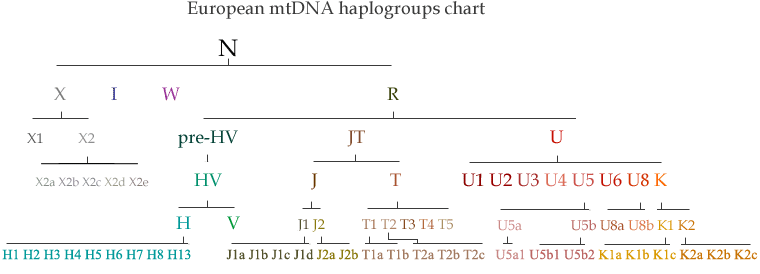
Human mitochondrial DNA can be divided in genealogical groups sharing a common maternal ancestor. These are called haplogroups, and they are used in population genetics to trace back (pre)historical population movements. You can sort each haplogroup in the table by frequencies by clicking on the name of a haplogroup.
Mitochondrial DNA haplogroups or subclades can sometimes reveal some potential medical conditions (see diseases associated with mtDNA mutations).
The column for haplogroup U includes U1, U6, U7, U8 and U9. Note that figures are only indicative. The higher the sample size the more accurate the frequencies, although significant regional variations are the norm in larger countries. A non-exhaustive list of the sources used for this page can be found here.
The samples for the Sami people of Lapland come from Norway (n=278), Sweden (n=152) and Finland (n=69) and only include traditional Sami.