Geographic distribution
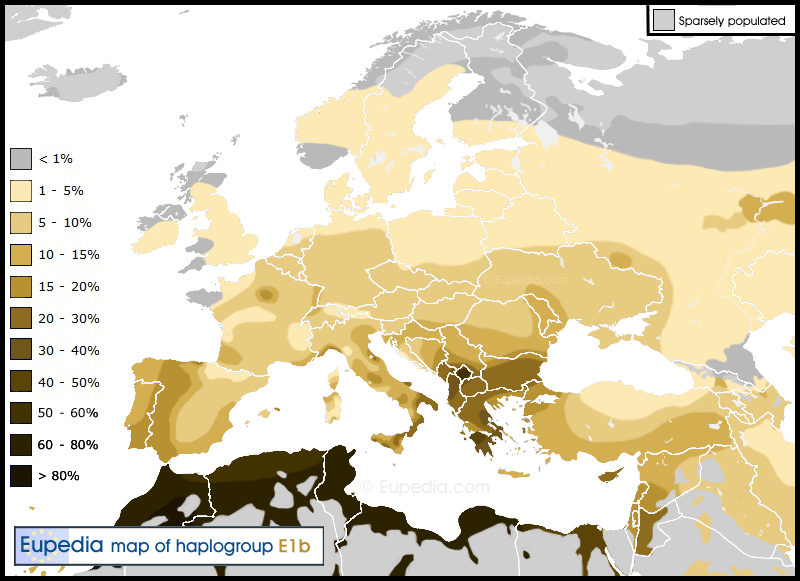
Outside Europe, E1b1b is found at high frequencies in Morocco (over 80%), Somalia (80%), Ethiopia (40% to 80%), Tunisia (70%), Algeria (60%), Egypt (40%), Jordan (25%), Palestine (20%), and Lebanon (17.5%). On the European continent it has the highest concentration in Kosovo (over 45%), Albania and Montenegro (both 27%), Bulgaria (23%), Macedonia and Greece (both 21%), Cyprus (20%), Sicily (20%), South Italy (18.5%), Serbia (18%) and Romania (15%). Ashkenazi Jews have approximately 20% of E1b1b, which falls mostly under specific clades of E-M123.
Distribution of haplogroup E1b1b in Europe, the Near East and North Africa
Phylogeny of E1b1b
If you are new to genetic genealogy, please check our Introduction to phylogenetics to understand how to read a phylogenetic tree.

- E-V22 is found primarily in western Ethiopia, northern Egypt and in the southern Levant. In Europe it is therefore associated with the Phoenicians and the Jews. The Phoenicians could have disseminated E-V22 to Sicily, Sardinia, southern Spain and the Maghreb, and the Jews to Greece and mainland Italy and Spain.
- E-V12 is the most common subclade of M78 in southern Egypt (over 40% of the population), while its V32 subclade is the dominant paternal lineage in Somalia, southern Ethiopia and northern Kenya. The moderate presence of V12* in the Near East and across Europe (except Nordic countries) indicates that it could have been a minor Neolithic lineage. Its V32 subclade has not been found outside Northeast Africa.
- E-V65 is found chiefly in North Africa, with a maximum frequency (20-30%) observed in Libya, Tunisia and northern Morocco. The absence of V65 from the Horn of Africa means that it would have originated in North Africa. Its TMRCA is very young, only 2,700 years. V65 has also been found at lower frequencies (0.5% to 5%) in Egypt, Greece, southern Italy, Sicily, and more interestingly among the Sardinians and the Basques, two population isolates with strong affinities with the Neolithic and Mesolithic populations of Europe, but both mostly lacking E-V13. However, V65 has not been found in the Levant, the Balkans or in non-Mediterranean Europe, which disproves a Neolithic dispersal. Its strongly North African distribution and very minor presence in parts of southern Europe with historical links to North Africa would rather suggest that this lineage was brought to southern Europe by immigrants from North Africa. In the case of Italy this could have taken place any time from the Phoenician/Carthaginian period (c. 1000-146 BCE) until the Vandal Kingdom. In Greece, V65 could have come from the ancient colonies of Cyrenaica. In Iberia, V65 could have crossed the Strait of Gibraltar any time since the late Paleolithic.
The frequency of E subclades has varied geographically over time due to founder effects in Neolithic, Bronze Age and Iron Age populations, i.e. the migration of a small group of settlers carrying among whom one paternal lineage was much more common than any others. Examples of founder effects include E-V12 in southern Egypt, E-V13 in the Balkans, E-V32 in Somalia, E-V65 on the Mediterranean coast of Africa, and E-M81 in Northwest Africa.
Origins
Red Sea origins & Neolithic expansion
Haplogroup E1b1b (formerly known as E3b) represents the last major direct migration from Africa into Europe. It is believed to have first appeared in the Horn of Africa approximately 26,000 years ago and dispersed to North Africa and the Near East during the late Paleolithic and Mesolithic periods. E-M78 and E-Z827 originated respectively at 20,000 years and 24,000 years. E1b1b lineages are closely linked to the diffusion of Afroasiatic languages.
Lazaridis et al. (2016) tested the first ancient DNA samples from the Mesolithic Natufian culture in Israel, possibly the world's oldest sedentary community, and found that the male individuals belonged either to haplogroups CT or E1b1 (including two E1b1b1b2 samples). These are to date the oldest known E1b1b individuals. The same haplogroups show up in Pre-Pottery Neolithic B Jordan, accompanied by new haplogroups (H2 and T). Besides, E1b1b was not found in Neolithic Iran or Anatolia, and only showed up twice among the hundreds of Neolithic European samples that have been tested. This evidence suggests that at the end of the last glaciation 12,000 years ago, E1b1b men were present in the Levant, but not in other parts of the Near East. There is evidence that the Natufians already cultivated cereals like rye before the Neolithic period. Cereal farming may therefore trace its roots (literally) to the E1b1b tribes of the Mesolithic Levant.
Marieke van de Loosdrecht et al. (2018) tested the DNA of seven 15,000-year-old modern humans from Taforalt Cave in northeastern Morocco, and all of the six males belonged to haplogroup E-M78. Autosomally they could be modelled as 2/3 Natufian and 1/3 Sub-Saharan African (West African), confirming the close genetic link between Late Paleolithic North Africans and Mesolithic South Levantines.
Nowadays, the highest genetic diversity of haplogroup E1b1b is observed in Northeast Africa, especially in Ethiopia and Somalia, which also have the monopoly of older and rarer branches like M281, V6 or V92. This suggests that E1b1b may indeed have appeared in East Africa, then expanded north until the Levant. Nevertheless, many lineages now found among the Ethiopians and Somalians appear to have come from the Fertile Crescent during the Neolithic period. This includes some E1b1b subclades like V22 (12,000 years old) and V32 (10,000 years old), but also undeniably Near Eastern lineages like T1a-CTS2214 and J1-L136.
North African Neolithic cattle herder hypothesis
Decker et al (2013) reported that Iberian and Italian cattle possess introgression from African taurine, which could imply that cattle were not just domesticated in West Asia, but also independently in North Africa. If that is the case, E-M78 or E-M123 could have come to southern Europe through North African cattle herders during the Neolithic, although this hypothesis remains purely conjectural. See also : Southern Neolithic route brought Megaliths from the Levant to Western Europe.
E1b1b1a1a1a (V13)
Geographic distribution
Distribution of haplogroup E-V13 in Europe, the Middle East & North Africa

Subclades
Origins & History
Assimilation of Neolithic European E-V13 by the Indo-Europeans
For many years the vast majority of academics have assumed that E-V13 and other E1b1b lineages came to the Balkans from the southern Levant via Anatolia during the Neolithic, and that the high frequency of E-V13 was caused by a founder effect among the colonisers. This theory has it that E1b1b people were associated with the development of Neolithic lifestyle and the advent of agriculture in the Fertile Crescent and its earliest diffusion to Southeast Europe (Thessalian Neolithic) and Mediterranean Europe (Cardium Pottery culture). The testing of ancient DNA from the Natufian culture (Mesolithic Levant) and Pre-Pottery Neolithic Levant confirmed a high incidence of haplogroup E1b1b in that region. However, out of 69 Y-DNA samples tested from Neolithic Europe, only two belonged to that haplogroup: one E-M78 from the Sopot culture in Hungary (5000-4800 BCE), another E-M78 (c. 5000 BCE), possibly E-V13, from north-east Spain, and a E-L618 from Zemunica cave near Split in Croatia from 5500 BCE (Fernandes et al., 2016). Whether these E-M78 samples came with Neolithic farmers from the Near East or were already present among Mesolithic Europeans is unclear at present. But in any case E-V13 was definitely not the major Neolithic European lineage it was once alleged to be.
Nowadays E-V13 is the only Mediterranean haplogroup consistently found throughout Europe, even in Norway, Sweden, Finland and Baltic countries, which are conspicuous by the absence of other Neolithic haplogroups like G2a (bar the Indo-European G2a-Z1815), J1 and T (except in Estonia). However, since G2a is the only lineage that was consistently found in all Neolithic sites tested to date in Europe, the absence of Neolithic G2a lineages from Scandinavia and the Baltic implies that no Neolithic lineage survives there, and consequently E-V13 does not date from the Neolithic in the region.
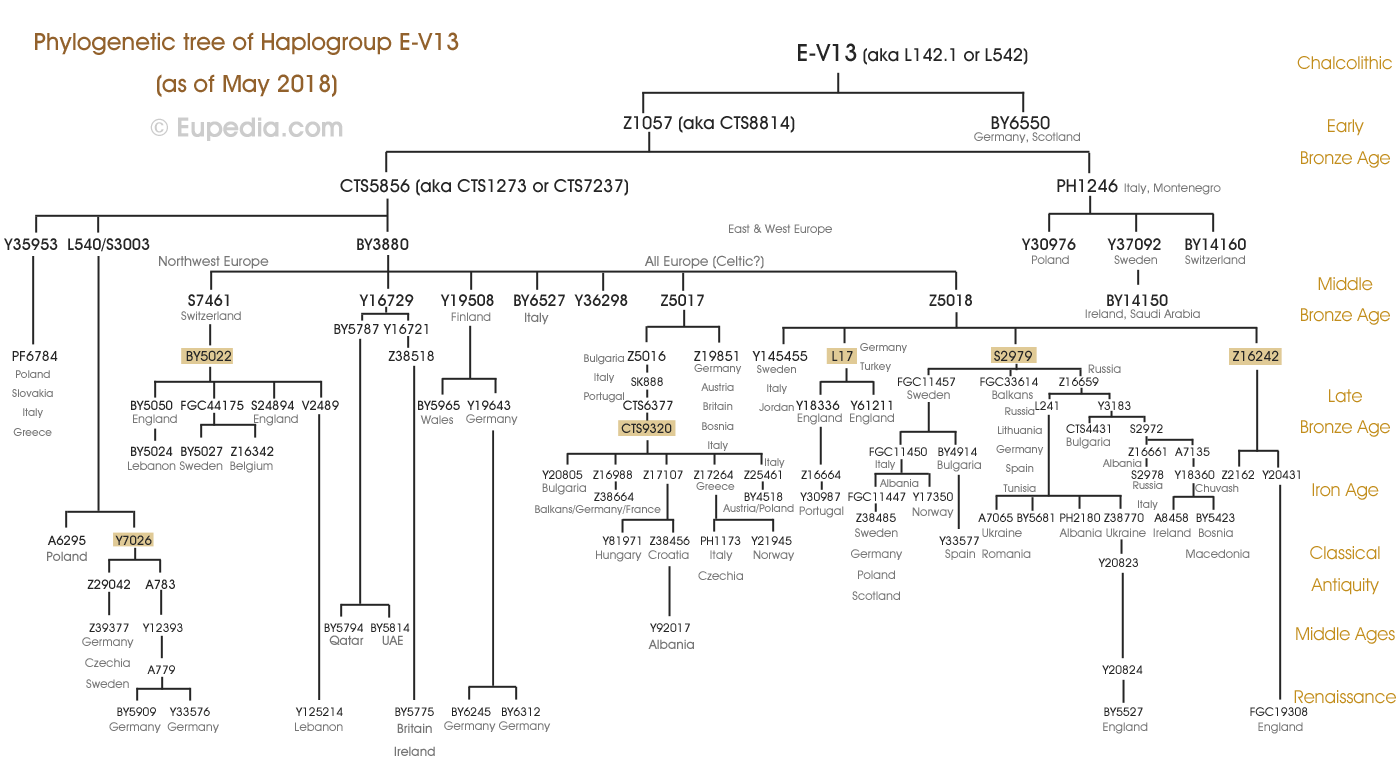
In fact, it has been calculated that E-V13 emerged from E-M78 some 7,800 years ago, when Neolithic farmers were advancing into the Balkans and the Danubian basin. Furthermore, all the modern members of E-V13 descend from a common ancestor who lived approximately 5,500 years ago, and all of them also descend from a later common ancestor who carried the CTS5856 mutation. That ancestor would have lived about 4,100 years ago, during the Bronze Age. Almost immediately afterwards, CTS5856 split into six subclades, then branched off into even more subclades in the space of a few generations. In just a few centuries, that very minor E-V13 lineage had started an expansion process that would turn it into one of Europe's most widespread paternal lineages and reach far beyond the borders of Europe itself, also spreading to the eastern edge of the Mediterranean, the Caucasus, Kurdistan, Iran, and even Siberia.
This data suggests that the fate of E-V13 was linked to the elite dominance of Bronze Age society. The geographic distribution of the six main branches show that E-V13 quickly spread to all parts of Europe, but was especially common in Central Europe. The only Bronze Age migration that could account for such a fast and far-reaching dispersal is that of the Proto-Indo-Europeans. At present the most consistent explanation is that E-V13 developed from E-M78 in Central or Eastern Europe during the Neolithic period, and was assimilated by the R1a and R1b Proto-Indo-Europeans around the time that they were leaving the Pontic Steppe to invade the rest of Europe.
What is surprising with E-V13 is that it is as common in R1a-dominant as in R1b-dominant countries. R1a Indo-European tribes are associated with the Corded Ware culture, which spanned across Northeast Europe, Scandinavia and the northern half of Central Europe. R1b tribes invaded the Balkans, the southern half of Central Europe, and joined up with Corded Ware people in what is now Germany, the Czech Republic and western Poland. If E-V13 was found among both groups, it would have needed to be either assimilated in the Pontic Steppe or very near from it (say, in the Cucuteni-Trypillian culture, around western Ukraine, Moldova and Romania), or at the junction between the two groups in central Europe (e.g. around the Czech Republic).
The distribution and age of E-V13 clades in central and western Europe are consistent with a dispersal by Hallstatt and La Tène Celts, Italic tribes (including a Roman redistribution) and the later influx of Germanic tribes, particularly the Goths, who may have assimilated additional Proto-Slavic E-V13 lineages in East Germany, Poland and Ukraine before entering the Roman Empire. (=> see also the discussions Was E-V13 a major lineage of Hallstatt Celts and Italics? and Ancient East, West and North Germanics had different Y-DNA lineages).
Amorim et al. (2018) tested the ancient DNA from 6th century Italy and Hungary and identified one E-V13 in Collegno (Turin) who was autosomally fully Italian (not a Lombard immigrant like many other samples tested).
The eastern advance of the Corded Ware culture eventually gave rise to the Sintashta culture in the Ural region, which is the ancestral culture of the Indo-Iranian branch of Indo-Europeans. E-V13's presence in this culture would explain why modern Iranians and Kurds possess E-V13, in addition to R1a-Z93 and R1b-Z2103. E-V13 has been found as far away as central Siberia, near the Altai, a region also known to have been settled by Bronze Age Indo-Europeans.
Due to the scarcity of full genomic sequences available from the Balkans, it is not yet clear when E-V13 expanded in that region. The Indo-European migrations would certainly have brought some E-V13 early on, from circa 2500 BCE. But the history of the region is so complex that there might be many separate branches of E-V13 that each came with a different invasion (e.g. Iranic tribes, La Tène Celts, Romans, Goths, Slavs). The first Indo-European migration to Greece was that of the Mycenaeans from c. 1650 BCE. The Dorians from Central Europe followed from c. 1200 BCE. Both could have brought different subclades of E-V13, and a founder effect or the phenomenon of elite dominance among the ruling invaders might have caused a fast growth of E-V13 lineage in Late Bronze Age and Iron Age Greece.
There are at least three distinct sources of E-V13 in Italy. The first would be the Bronze Age Italic tribes from Central Europe, who in all logic would have possessed at least some E-V13 lineages before they invaded the Italian peninsula. Proto-Italics would have been a predominantly R1b-U152 tribe, but also carried a minority of E-V13, G2a-L140 (L13, L1264 and Z1816 subclades) and J2a1-L70 (PF5456 and Z2177 subclades). The second would be the ancient Greeks, who heavily colonized southern Italy from the 9th century BCE until the Roman conquest in the 3rd century BCE. The third are the Goths. As a Germanic tribe they might have carried a small percentage of E-V13. But that percentage very certainly increased after spending several centuries in Central and Southeast Europe and assimilating Proto-Slavs and Balkanic people before invading Italy. The Goths settled over all the Italian peninsula. They would have brought typically Germanic lineages like I1 and R1b-U106, but also the Proto-Slavic R1a-CTS1211, which is now found uniformly in 1 to 2% of the population. Since R1a-CTS1211 is not originally Germanic, it is likely that the Goths also brought a small but noticeable percentage of assimilated lineages from the Balkans, including E-V13 and J2b1 (I2a1b-CTS10228 would have come later from the East Slavic migrations from Ukraine during the Early Middle Ages, hence its absence from Italy, apart from a few coastal areas facing the Adriatic Sea).
An Indo-European dispersal of V13 subclades would not only explain why E-V13 is present in places like Finland, northwest Russia or Siberia, where Neolithic farmers had a negligible impact, but also why E-V13 is so conspicuously lacking from the Basque country and (central) Sardinia, the two regions of Europe with the highest Neolithic ancestry. Sardinia is also the only part of Europe where Bronze Age Steppe ancestry is virtually absent. The low percentage of E-V13 is coastal Sardinia would be better explained by more recent settlements on the island by the Romans, or even the Goths, who also settled in Sardinia.
The small presence of E-V13 in the Near East could be better explained by the extremely long Greek presence in the eastern Mediterranean from the time of Alexander the Great until the end of the Byzantine domination over the region during the Middle Ages. It would be unthinkable that over 1,500 years of Hellenisation and Byzantine rule in Anatolia and the Levant didn't leave any genetic trace. In Anatolia, E-V13 is found mostly in the western third of the country, the region that used to belong to ancient Greece. The absence of E-V13 from Central Anatolia does not concord with a diffusion linked to Neolithic agriculture. There is clearly a radiation from the Greece (where E-V13 makes up approximately 30% of the paternal lineages) to the East Mediterranean (where the frequency drops to under 5%).
E1b1b1b1a (M81)
Geographic distribution
Distribution of haplogroup E-M81 in Europe, the Middle East & North Africa
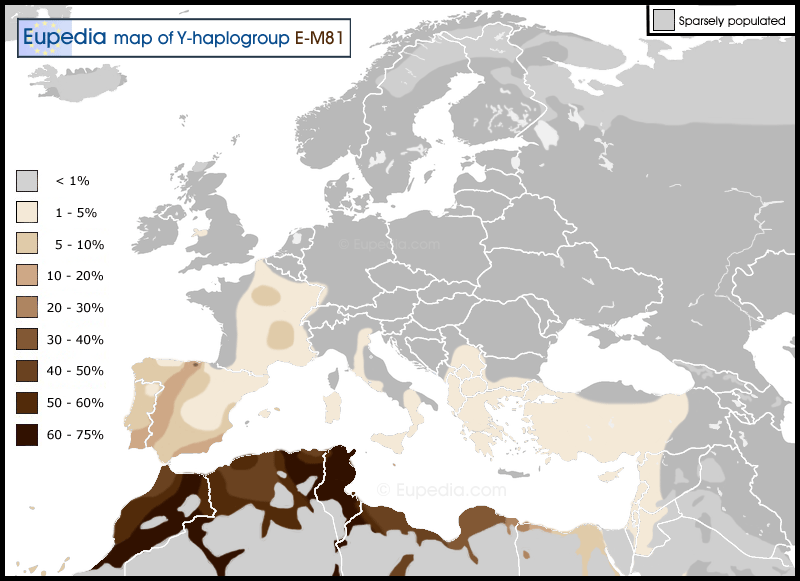
E-M81 is found at an average frequency of 45% in the Maghreb and Libya, with peaks at over 60% in Tunisia as well as central and southern Morocco. It is especially common among Berber populations all over Northwest Africa, including the Tuaregs. Frequencies of over 75% have been reported among the Tuaregs of Burkina Faso and Mali.
In Europe, M81 is most common in Portugal (8%), Spain (4%), as well as in France (0-6%) and Italy (0-4%), where strong regional variations are observed. M81 is especially common in western Iberia, notably Extremadura (15.5%), Andalusia (13.5%), southern Portugal (11%), the Canary Islands (11%), north-west Castille (10%) and Galicia (10%). The highest percentage of E-M81 in Europe is found among the Pasiegos (30%, n=101), an isolated community living in the mountains of Cantabria.
Note the resemblance between the distribution of E-M81 and the African admixture from the Dodecad project.
Origins & History
Nowadays E-M81 is the dominant paternal lineage among Northwest Africans, and particularly Tuaregs, Mountain Moroccans, Tunisians and Libyans. Outside North Africa, M81 is far more frequent in parts of Iberia than anywhere else in Europe or the Near East. The M81 clade is defined by 150 other mutations beside M81 itself. This branch split from E1b1b during the late glacial period, approximately 14,000 years ago. It would be easy to assume that E-M81 colonised Northwest Africa during the Mesolithic or Neolithic period, then spread to southern and western Europe with the southern wave of Neolithic farmers that crossed over from Morocco to Iberia, then spread around western Europe with the Megalithic people. Yet, according to TMRCA (Time of Most Recent Common Ancestor) estimates, all carriers of this haplogroup descend from a common ancestor who lived only 2,100 years ago, about 5,000 years too late for the Neolithic hypothesis to hold ground.
The story of M81 is very unusual in that it is so young and diversified into a multitude of subclades within just a few centuries. M81 has two immediate subclades A5604 and M183 (aka PF2477 or PF2546). Under the latter no less than eight subclades have been identified at present: A930, A2227, CTS12227, FGC22844, PF2578, PF6794, MZ99 and Z5009. This indicates that a single man may have had nine sons who went on to have numerous children of their own. What is even more surprising is that these subclades do not show any consistent geographic pattern.
If the estimate of 2,100 years is correct, that would correspond approximately to the time when the Romans defeated the Carthaginians in what is now Tunisia. That would mean that the M81 lineage only started to expand in Roman times, and continued to diffuse within all the borders of the Roman Republic/Empire - not just North Africa, but also Iberia, France, Italy, Greece, Turkey and the Levant. This is a remarkably fast expansion that would have required a male line of considerable wealth and influence within the Roman Republic/Empire, and therefore probably a family of rich patricians or even a Roman emperor, not necessarily of Roman descent himself. The advantage of this hypothesis is that M81 is indeed found exclusively within the borders of the Roman Empire, and in a big part of the empire. Even within Britain it is found mainly in Wales, a region known to have served as a refuge for the Romano-British population during the Anglo-Saxon invasions.
Of course, the TMRCA is only an estimate and could vary by a few centuries. Therefore this lineage could actually have emerged a few centuries earlier, during the Phoenician/Carthaginian period. Indeed the distribution pattern and frequency of M81 matches much better the Phoenician maritime empire, with its origins in the Levant, and its dispersal along the cost of North Africa, but also Iberia, Sardinia and Sicily. In this scenario, M81 could have been the lineage of Carthaginian kings, or of a particularly prolific aristocratic familiy during the Carthaginian Republic. The merits of this hypothesis is that it would explain why M81 is so much more common in the Maghreb, and particularly in Tunisia, than in Italy today. The Carthaginians founded cities in Spain, including Carthago Nova (the New Carthage, now Cartagena in Murcia), but also in Sardinia and Sicily, where M81 is the most common today within Italy. The weak point of this hypothesis is that it doesn't explain how M81 reached places like France, Britain, Greece or Turkey, nor even northern Spain.
In whichever scenario, it is clear that M81 benefited from a potent founder effect in the Maghreb, a region that was first dominated by the Carthaginian elite, but quickly became one of the favourite regions of residence for the Roman elite within the empire (along with Spain, France and Greece). Therefore both hypotheses are plausible. A combination of the two scenarios could provide an even better explanation. M81 would first have spread with the Carthaginian elite, then once they were defeated by the Romans and annexed to the empire, their descendants would have been free to migrate to various parts of the empire from North Africa, Sicily, Sardinia and Iberia, some eventually reaching France and Britain. The original Phoenician M81 in the Levant could also have diffused across the Eastern Mediterranean over the centuries, during the Roman, Byzantine and Ottoman periods.
Whether origins of M81 lie in the Carthaginian or Roman elite, its parent clades M310.1 and Z827 would have originated in the Levant, and not in Northwest Africa. Z830, M310.1's brother clade, is almost exclusively Middle Eastern. M310.1 itself dates from the Late Paleolithic and could have come to Italy via Anatolia and Greece any time between the Late Glacial period and the Iron Age, including with Neolithic farmers or the Minoans during the Bronze Age.
In either case, it is likely that more M81 came into the Iberian peninsula during the Moorish period, when the Maghrebian Arabs conquered most of what is now Spain and Portugal, where they remained for over 700 years. The Moors also conquered Sicily.
E1b1b1b2a (M123)
Geographic distribution
Distribution of haplogroup E-M123 in Europe, the Middle East & North Africa

The highest frequencies of E-M123 are observed in Jordan (31% near the Dead Sea), Ethiopia (5-20%), Israel/Palestine (10-12% among the Palestinians and the Jews), among the Bedouins (8%), in Lebanon (5%), in North Africa (3-5%), Anatolia (3-6%) and southern Europe, particularly Italy (1 to 8%), in the Spanish region of Extremadura (4%), and the Balearic islands of Ibiza and Minorca (average 10%).
Subclades
Origins & History
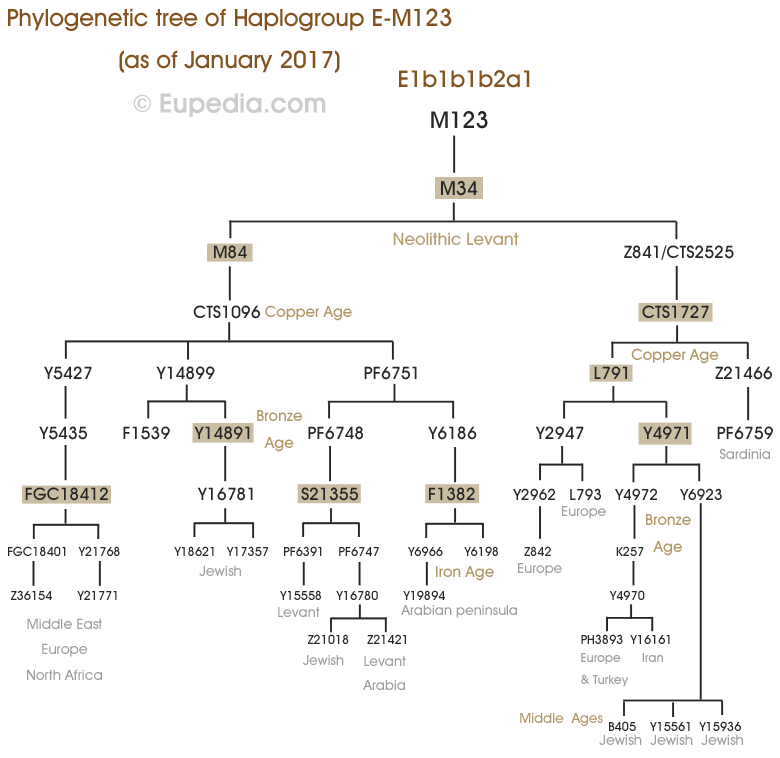
E-M123 originated some 19,000 years ago, during the last Ice Age Its place of origin is uncertain, but it was probably in the Red Sea region, somewhere between the southern Levant and Ethiopia. Its main subclade E-M34 most probably emerged in the Levant about 15,000 years ago. Soon afterwards, M34 split into two branches, M84 and Z841, which were probably found in the Fertile Crescent during the Neolithic period. It is not clear at present whether they expanded beyond the Near East during the Neolithic period, but they might have been part of the Neolithic expansion to North Africa and Iberia alongside haplogroups T1a and/or R1b-V88. L791 and Z21466 have a mostly European distribution today and their ages point toward a Neolithic diffusion. The PF6759 subclade seems to have reached Sardinia during the Neolithic period. The descendants of L791, Y2947 and Y4971, only appeared around 3500 BCE, during the Late Neolithic or Chalcolithic period. The K257 and Y4970 branch emerged around 3000 BCE and is found in Iran, Armenia, Turkey, Russia, Greece, Italy and France, among others. It might be linked to the expansion of the Kura-Araxes culture from the southern Caucasus to Anatolia and Iran. It would then have spread to Greece and Italy alongside haplogroup J2a1 and T1a-P77. Y6923 also emerged around 3500 BCE, but became almost extinct. All modern carriers of this lineage descend from a common ancestor who lived only 1,200 years ago, and all are Ashkenazi Jews.
E-M34 lineages experienced a much more dramatic expansion during the Chalcolithic (Copper Age) period. CTS1096 split into three subclades around 7,500 to 7,000 years ago, a period that corresponds to the advent of the Copper Age around modern Kurdistan. These lineages continued to expand around the Middle East, Greece and Italy during the Bronze Age. Nowadays, the FGC18412 (aka Y5412) clade is the main variety of M123 found in Europe. Also downstream of CTS1096, the Y14891 and Z21018 clades are typically found among people of Jewish ancestry, while PF6391 and Z21421 are found in the Levant (Syria, Lebanon, Palestine, Jordan) and the Arabian peninsula. F1382 appears to have expanded during the Iron Age from the Levant to the Arabian peninsula, where it is almost exclusively found today.
Phoenician, Greek and Roman diffusions of E-M34
The classical antiquity brought new waves of colonisation across the Mediterranean. The first colonists were Phoenicians, who came from present-day Lebanon and the Tartus province of Syria. The Phoenicians possessed a variety of paternal lineages reflecting the complex ancient history of the Middle East. One of them was E-M34 (notably Levantine clades like Y15558 and Z21421), which makes up about 15% of modern Lebanese Y-DNA, but was probably higher before the Greek, Roman, Arabic, Byzantine, medieval crusader and Ottoman occupations altered the local gene pool. E-M34 is the main Middle Eastern variety of E1b1b and is thought to have arrived with the Proto-Semitic people in the Late Copper to Early Bronze Age. The Phoenicians would have spread E-M34 to Cyprus, Malta, Sicily, Sardinia, Ibiza and southern Iberia.
The ancient Greeks contributed to the rediffusion of more E-M34 (and E-V13) around places such as Cyprus, Sicily, southern Italy, Liguria, Provence, eastern Spain, and basically all part of the Classical ancient Greek world. Alexander's conquest of the Middle East would have taken Greek male lineages much further afield, perhaps as far as Afghanistan and Pakistan, although only at trace frequencies. The Greeks remained in control of the Middle East until the Roman conquest, then regained influence over the region during the Byzantine period. It is likely that most E-V13 in the Middle East is ultimately of Greek or Roman origin, although some might have come with Bronze Age Indo-European migrations via Iran.
Migrations within the Roman Empire probably played a role, although a minor one, in the redistribution of E1b1b in Europe.
Famous individuals
E-V13 branch

Gjergj Kastrioti Skënderbe, also known as Skanderbeg (1405-1468), was an Albanian feudal lord and military commander who led a rebellion against the Ottoman Empire in what is today Albania, North Macedonia, Greece, Kosovo, Montenegro and Serbia. One of his patrilineal descendants was identified as a member of haplogroup E-V13 > Z17107.

The Scottish Clan Colquhoun/Calhoun from Dunbartonshire belongs to the clade E-V13 > BY3880 > Y16729 > Y16721 > Y16733 according to the Calhoun Surname Project. The most prominent member is probably John C. Calhoun (1782–1850), who was the seventh Vice President of the United States. He is best remembered for being a strong defender of slavery. His beliefs and warnings heavily influenced the South's secession from the Union in 1860–61.

Giuseppe Garibaldi (1807-1882), the general, politician and nationalist who played a large role in the history of Italy, probably belonged to haplogroup E-V13 based on the Y-DNA results from another Garibaldi from the same province in his ancestral Liguria.

The Wright Brothers, the inventors of the world's first successful airplane, belonged to haplogroup E-V13 (S7461 subclade). They were supposedly descended from John Wright (1488-1551), of Kelvedon Hall, Essex, England, which allowed the Wright Surname DNA Project to isolate their paternal lineage based on the matching haplotypes of over 20 participants descending from that lineage.

According to the DNA results of a relative, Google co-founder Larry Page (b. 1973) might belong to haplogroup E-V13. As of November 2016, he was the 12th richest person in the world.
E-M34 branch

The Harvey Y-DNA Genetic Project managed to retrace the ancestry and identify the Y-chromosomal haplogroup of William Harvey (1578 -1657), the first person to describe completely and in detail the systemic circulation and properties of blood being pumped to the body by the heart. He belonged to the subclade E-M34.

Gérard Lucotte et al. (2012) recovered the DNA of Napoleon Bonaparte from beard hair follicules and compared his Y-DNA to that of one of his present-day descendants, Charles Napoléon. They established that both men belonged to haplogroup E-M34, a subclade which is thought to have reached Mediterranean Europe from the Levant during the Neolithic period. Napoleon I had previously been identified by Lucotte's team as a member of mtDNA haplogroup H.

The acclaimed theoretical physicist Albert Einstein is presumed to have belonged to Y-haplogroup E-Z830 based on the results from a patrilineal descendant of Naphtali Hirsch Einstein, Albert Einstein's great-grand-father. Approximately 20% of Ashkenazi Jews belong to haplogroup E1b1b.

Steven Pinker is a Canadian experimental psychologist, cognitive scientist, linguist, and popular science author. He is Johnstone Family Professor in the Department of Psychology at Harvard University, and is known for his advocacy of evolutionary psychology and the computational theory of mind.

The American actor and producer Nicolas Cage (born 1964),has been found to belong to haplogroup E1b1b-M84. His real name is Nicolas Kim Coppola, and his paternal great-grand-father emigrated to the U.S. from the South Italian town of Bernalda in Basilicata. He is the nephew of screenwriter, film director and producer Francis Ford Coppola, who shares the same haplogroup.
E-M81 branch

Franz Kafka, a German-speaking Bohemian novelist and short-story writer, who is widely regarded as one of the major figures of 20th-century literature probably belonged to E-Y161794, a Jewish branch of haplogroup E-M81, based on the Y-DNA test of another Kafka from Czechia at FTDNA.

The French footballer of Algerian origin Zinedine Zidane (born 1972), is a member of haplogroup E1b1b (M81) according to his brother's DNA test. Zidane was named the best European footballer of the past 50 years in the UEFA Golden Jubilee Poll.
Undetermined E1b1b branch

The remains of the great Italian Baroque painter Caravaggio (1571-1610) were excavated to confirm the circumstances of his mysterious death at the age of 38. His DNA was compared to modern carriers of the same surname. The study revealed that he belonged to haplogroup E1b1b1.

Ronny Decorte, a geneticist from the Catholic University of Leuven in Belgium, tested relatives of Adolf Hitler and determined that the Fürher belonged to haplogroup E1b1b. Ironically this haplogroup thought to be at the origin of Afro-Asiatic languages, which includes the Semitic languages and peoples that Hitler despised so much.

Sir David Attenborough (b. 1926), an English broadcaster and naturalist at the BBC explained in the Tree of Life how the Attenboroughs belonged to haplogroup E1b1b1. In 2002 he was named among the 100 Greatest Britons following a UK-wide vote. His brother is the producer, director and actor Richard Attenborough (b. 1923 - pictured), who won two Academy Awards for Gandhi in 1983.
Other famous members of haplogroup E1b1b
- Tom Conti (subclade E-M34) : is a Scottish actor, theatre director and novelist of Italian Scots descent. He has won a Tony Award for Best Actor in a Play in 1979 for his performance in Whose Life Is It Anyway? His haplogroup was revelaved to be E-M34 by BritainsDNA.
- George Stroumboulopoulos : is a Canadian television and radio personality. He is best known as formerly being a VJ for the Canadian music television channel MuchMusic and being the host of the CBC Television talk show George Stroumboulopoulos Tonight (formerly The Hour) from 2005 to 2014.
Read this article in other languages
Follow-up
Ask your questions and discuss about haplogroups on the Forum